Introduction
DevOps has become one of the most important career paths in modern IT. Organizations today need faster software delivery, reliable infrastructure, secure deployments, automated operations, and scalable cloud platforms. Because of this, companies are actively hiring DevOps engineers, cloud engineers, SRE professionals, platform engineers, and DevSecOps specialists.
However, choosing the best DevOps certification is not easy anymore. There are hundreds of certification programs covering Docker, Kubernetes, Terraform, AWS, Azure, CI/CD, monitoring, GitOps, and cloud-native engineering. Many learners start with random tools without understanding the proper DevOps roadmap.
A common mistake beginners make is jumping directly into Kubernetes or advanced cloud engineering without learning Linux, networking, Git, automation, and infrastructure fundamentals first. This creates confusion and slows down career growth. Certifications help only when they follow a practical learning sequence.
Modern DevOps is no longer limited to automation scripts and CI/CD pipelines. Today, DevOps involves cloud-native infrastructure, Infrastructure as Code, Kubernetes orchestration, security automation, observability, platform engineering, and reliability engineering. The industry expects engineers to understand real-world deployment pipelines and scalable systems.
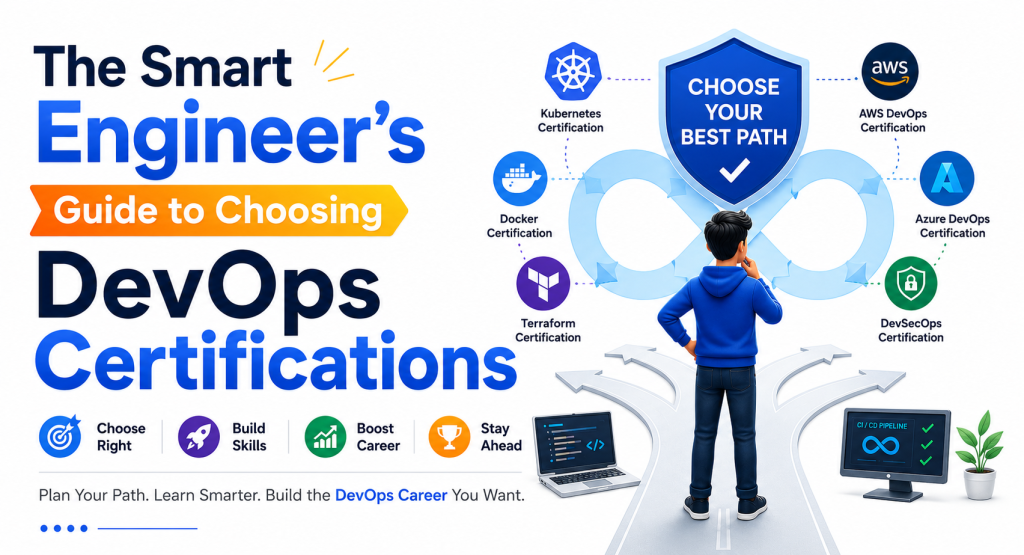
This guide helps you understand the complete DevOps certification roadmap in a practical and career-focused way. Whether you are a fresher starting from scratch or an experienced engineer planning advanced Kubernetes and cloud certifications, this article will help you choose the right path.
Why DevOps Certifications Matter
DevOps certifications are valuable because they provide structured learning and industry-recognized validation. While certifications alone cannot replace real experience, they help learners organize their learning journey effectively.
Skill Validation
Certifications demonstrate that you understand key DevOps concepts, tools, and workflows. Recruiters often use certifications as proof of foundational knowledge.
Structured Learning
Most beginners struggle because they learn random tools from tutorials. Certifications create a structured roadmap covering:
- Linux
- Git
- CI/CD
- Containers
- Cloud platforms
- Infrastructure as Code
- Monitoring
- Kubernetes
Better Interview Preparation
Certification preparation improves practical understanding of:
- Deployment pipelines
- Container orchestration
- Cloud infrastructure
- Automation
- Security practices
- Troubleshooting
This directly helps during technical interviews.
Cloud-Native Demand
Modern companies increasingly rely on:
- Kubernetes
- Docker
- Terraform
- AWS
- Azure
- Google Cloud
- GitOps
- Monitoring systems
Certified engineers often gain better visibility in hiring pipelines.
DevSecOps Growth
Security automation is now a major requirement. Organizations need professionals who understand:
- Secure CI/CD
- Container security
- Secrets management
- Compliance automation
- Cloud security
Real-World Engineering Value
The best DevOps certifications focus on practical skills such as:
- Deploying applications
- Automating infrastructure
- Managing Kubernetes clusters
- Building CI/CD pipelines
- Monitoring systems
Salary Growth Opportunities
Cloud and DevOps roles continue to offer strong salary growth because companies need engineers capable of managing scalable distributed systems.
Who Should Read This Guide
This guide is useful for multiple career paths.
Freshers Entering DevOps
Beginners who want a structured roadmap instead of random tutorials.
Developers Moving into DevOps
Software engineers learning deployment automation, Kubernetes, and CI/CD.
Linux Administrators
System administrators transitioning into cloud-native infrastructure management.
Cloud Engineers
Professionals focusing on AWS, Azure, or Google Cloud automation.
Kubernetes Engineers
Engineers specializing in container orchestration and cloud-native deployments.
DevSecOps Learners
Security-focused engineers automating compliance and secure pipelines.
Platform Engineers
Professionals building internal developer platforms and scalable infrastructure.
SRE Engineers
Engineers focusing on reliability, monitoring, observability, and incident response.
Types of DevOps Certifications
Foundation Certifications
Foundation certifications are ideal for beginners.
These certifications teach:
- DevOps culture
- CI/CD basics
- Automation principles
- Collaboration workflows
- Agile integration
- Deployment fundamentals
Best starting point for newcomers.
Tool-Based Certifications
Docker Certification
Focuses on:
- Containers
- Docker images
- Container networking
- Docker Compose
- Container security
Kubernetes Certification
Focuses on:
- Cluster management
- Pods and deployments
- Networking
- Scaling
- Storage
- Security
Terraform Certification
Focuses on:
- Infrastructure as Code
- Cloud automation
- Terraform modules
- State management
- Multi-cloud deployments
Jenkins Certification
Covers:
- CI/CD pipelines
- Build automation
- Pipeline scripting
- Deployment workflows
Git and Linux Certifications
Essential for every DevOps engineer.
Cloud DevOps Certifications
AWS DevOps Certification
Covers:
- CI/CD
- Monitoring
- Infrastructure automation
- Cloud deployment
- Logging
- Security
Azure DevOps Certification
Focuses on:
- Azure pipelines
- IaC
- Monitoring
- Governance
- Deployment automation
Google Cloud DevOps Certification
Focuses on:
- Site reliability
- Monitoring
- Kubernetes
- Cloud-native deployments
DevSecOps Certifications
Covers:
- Container security
- Secrets management
- Compliance
- Secure CI/CD
- Vulnerability scanning
- Security automation
SRE and Platform Engineering Certifications
Focuses on:
- Observability
- Monitoring
- Reliability engineering
- Incident management
- Scalability
- Platform automation
Advanced Certifications
Modern advanced certifications include:
- GitOps
- MLOps
- AIOps
- FinOps
- Platform Engineering
- Observability Engineering
Best DevOps Certifications at a Glance
| Certification | Best For | Level | Difficulty | Main Skills | Career Scope |
|---|---|---|---|---|---|
| DevOps Foundation | Beginners | Beginner | Easy | CI/CD, DevOps basics | Entry-level DevOps |
| Docker Certified Associate | Containers | Intermediate | Medium | Docker, containers | Container Engineer |
| Kubernetes Certification | Kubernetes engineers | Intermediate | High | Kubernetes orchestration | Cloud-native engineering |
| Terraform Associate | Infrastructure automation | Intermediate | Medium | IaC, automation | Cloud automation |
| AWS Certified DevOps Engineer | AWS engineers | Advanced | High | AWS automation | Cloud DevOps |
| Azure DevOps Engineer Expert | Azure professionals | Advanced | High | Azure DevOps | Enterprise cloud |
| Google Cloud DevOps Engineer | GCP engineers | Advanced | High | SRE, monitoring | Cloud reliability |
| DevSecOps Certification | Security-focused roles | Intermediate | Medium | Secure CI/CD | DevSecOps |
| SRE Certification | Reliability engineering | Advanced | High | Monitoring, reliability | SRE engineering |
Certification Deep Dive
1- DevOps Foundation
What It Is
A beginner-friendly certification covering DevOps culture, CI/CD concepts, automation basics, Agile integration, and deployment workflows.
Who Should Take It
- Beginners
- IT students
- Freshers
- Developers exploring DevOps
Best Career Fit
- Junior DevOps Engineer
- CI/CD Engineer
- Automation Engineer
Difficulty Level
Beginner
Career Scope
Good starting point for understanding the DevOps ecosystem.
Skills You Will Learn
- DevOps principles
- CI/CD concepts
- Agile workflows
- Automation basics
- Collaboration models
- Deployment pipelines
Tools Covered
- Git
- Jenkins
- Docker basics
- CI/CD concepts
Exam Details
Varies by provider.
Study Roadmap
- Learn Linux basics
- Learn Git fundamentals
- Understand CI/CD
- Practice Docker basics
- Study DevOps workflows
Real-World Use Cases
Used for understanding software delivery pipelines and automation workflows.
Pros
- Beginner-friendly
- Easy entry point
- Structured roadmap
Cons
- Limited technical depth
- Not enough for advanced roles
Best Recommendation
Best for absolute beginners.
2- Docker Certified Associate
What It Is
A certification focused on containerization and Docker ecosystem management.
Who Should Take It
- Developers
- DevOps engineers
- Cloud engineers
Best Career Fit
- Container Engineer
- DevOps Engineer
- Platform Engineer
Difficulty Level
Intermediate
Career Scope
Containers remain foundational in modern cloud-native systems.
Skills You Will Learn
- Docker images
- Containers
- Networking
- Docker Compose
- Security
- Storage management
Tools Covered
- Docker
- Docker Compose
- Container registries
Exam Details
Varies by provider.
Study Roadmap
- Learn Linux
- Understand containers
- Build Docker images
- Deploy applications
- Practice networking and storage
Real-World Use Cases
Used in microservices deployment and CI/CD environments.
Pros
- Strong practical value
- Essential for Kubernetes
Cons
- Limited cloud coverage
Best Recommendation
Ideal before learning Kubernetes.
3- Certified Kubernetes Administrator
What It Is
One of the most respected Kubernetes certifications.
Who Should Take It
- Cloud engineers
- DevOps engineers
- SRE engineers
Best Career Fit
- Kubernetes Engineer
- Platform Engineer
- SRE Engineer
Difficulty Level
Advanced
Career Scope
Extremely high demand in cloud-native environments.
Skills You Will Learn
- Cluster administration
- Deployments
- Networking
- Scaling
- Troubleshooting
- Security
- Storage management
Tools Covered
- Kubernetes
- Helm
- kubectl
- Container runtimes
Exam Details
Performance-based practical exam.
Study Roadmap
- Learn Docker
- Learn Linux
- Understand Kubernetes architecture
- Practice cluster deployments
- Learn troubleshooting
Real-World Use Cases
Used for managing production Kubernetes clusters.
Pros
- High industry value
- Practical certification
- Strong cloud-native relevance
Cons
- Difficult for beginners
Best Recommendation
Best after Docker and Linux mastery.
4- Terraform Associate
What It Is
Infrastructure as Code certification for Terraform automation.
Who Should Take It
- Cloud engineers
- Infrastructure engineers
- DevOps professionals
Best Career Fit
- IaC Engineer
- Cloud Automation Engineer
Difficulty Level
Intermediate
Career Scope
IaC is now standard in cloud engineering.
Skills You Will Learn
- Terraform workflows
- Modules
- State management
- Cloud provisioning
- Automation
Tools Covered
- Terraform
- Cloud providers
Exam Details
Provider-specific.
Study Roadmap
- Learn cloud basics
- Understand Infrastructure as Code
- Practice Terraform modules
- Deploy infrastructure
Real-World Use Cases
Automated provisioning of cloud resources.
Pros
- High practical value
- Multi-cloud relevance
Cons
- Requires cloud knowledge
Best Recommendation
Excellent for cloud automation careers.
5- AWS Certified DevOps Engineer
What It Is
Advanced AWS automation and deployment certification.
Who Should Take It
- AWS engineers
- Cloud professionals
Best Career Fit
- AWS DevOps Engineer
- Cloud Automation Engineer
Difficulty Level
Advanced
Career Scope
Strong demand in enterprise cloud environments.
Skills You Will Learn
- AWS CI/CD
- Monitoring
- Automation
- Infrastructure deployment
- Security
Tools Covered
- AWS services
- CloudFormation
- Monitoring tools
- CI/CD services
Exam Details
Provider-specific.
Study Roadmap
- Learn AWS fundamentals
- Understand CI/CD
- Learn Terraform
- Build deployment pipelines
- Practice monitoring
Real-World Use Cases
Managing scalable AWS infrastructure.
Pros
- Strong enterprise demand
- Excellent salary potential
Cons
- Requires AWS experience
Best Recommendation
Best for experienced cloud engineers.
DevOps Certification Comparison Table
| Certification | Best For | Level | Main Focus | Difficulty | Career Scope | Recommended Role |
|---|---|---|---|---|---|---|
| DevOps Foundation | Beginners | Beginner | DevOps basics | Easy | Entry-level | Junior DevOps Engineer |
| Docker Certified Associate | Containers | Intermediate | Containers | Medium | High | Container Engineer |
| Kubernetes Certification | Kubernetes | Advanced | Orchestration | High | Very High | Kubernetes Engineer |
| Terraform Associate | IaC | Intermediate | Automation | Medium | High | Cloud Engineer |
| AWS DevOps Engineer | AWS automation | Advanced | Cloud DevOps | High | Very High | AWS DevOps Engineer |
| Azure DevOps Engineer | Azure DevOps | Advanced | Azure automation | High | High | Azure Engineer |
| Google Cloud DevOps Engineer | SRE | Advanced | Reliability | High | High | SRE Engineer |
| DevSecOps Certification | Security | Intermediate | Secure pipelines | Medium | High | DevSecOps Engineer |
| SRE Certification | Reliability | Advanced | Monitoring | High | High | SRE Engineer |
DevOps Certification Roadmap
Beginner Path
Start with foundational skills.
Recommended Learning Order
- Linux fundamentals
- Git and GitHub
- Networking basics
- Bash scripting
- Docker basics
- CI/CD fundamentals
- DevOps Foundation certification
Intermediate Path
Focus on automation and orchestration.
Recommended Learning Order
- Jenkins
- Terraform
- Kubernetes basics
- Cloud fundamentals
- Monitoring tools
Advanced Path
Specialize in scalable systems.
Recommended Learning Order
- Kubernetes certification
- AWS/Azure/GCP DevOps certification
- DevSecOps
- SRE engineering
- Observability
Specialized Path
Modern advanced specialization areas include:
- GitOps
- Platform engineering
- MLOps
- AIOps
- FinOps
- Service mesh
- Observability engineering
Recommended Certification Path by Role
DevOps Beginner
- Linux
- Git
- Docker
- DevOps Foundation
- Jenkins
Cloud Engineer
- Cloud fundamentals
- Terraform
- Docker
- Kubernetes
- AWS/Azure/GCP DevOps certification
Kubernetes Engineer
- Docker
- Linux
- Kubernetes basics
- Certified Kubernetes Administrator
- GitOps
Platform Engineer
- Kubernetes
- Terraform
- Observability
- GitOps
- Platform engineering tools
DevSecOps Engineer
- Linux
- CI/CD
- Container security
- Secrets management
- DevSecOps certification
SRE Engineer
- Linux
- Monitoring
- Kubernetes
- Reliability engineering
- Incident response workflows
Real-World Career Scenarios
Fresher Starting DevOps
A fresher should begin with:
- Linux
- Git
- Docker
- CI/CD basics
Jumping directly into Kubernetes often creates confusion.
Developer Learning Kubernetes
Developers moving into DevOps should first understand:
- Containers
- CI/CD
- Cloud deployment workflows
Then move into Kubernetes administration.
Sysadmin Moving into Cloud Automation
Linux administrators already have infrastructure knowledge. Their roadmap should focus on:
- Cloud platforms
- Terraform
- Kubernetes
- Automation
Cloud Engineer Transitioning into DevOps
Cloud engineers should strengthen:
- CI/CD
- Observability
- Kubernetes
- Infrastructure automation
Operations Engineer Becoming SRE
Operations professionals should focus on:
- Monitoring
- Reliability
- Incident management
- Observability
- Automation
Common Mistakes to Avoid
Starting Kubernetes Too Early
Kubernetes without Docker and Linux knowledge becomes difficult.
Ignoring Linux Basics
Linux remains foundational for DevOps engineering.
Skipping Networking
Networking knowledge is critical for troubleshooting deployments.
Learning Tools Without Projects
Projects matter more than collecting certificates.
Collecting Certificates Only
Employers value practical implementation skills.
Ignoring Cloud Fundamentals
Modern DevOps heavily depends on cloud infrastructure.
Depending Only on Tutorials
Hands-on labs are essential.
Hands-On Projects
CI/CD Pipeline Setup
Learn automated build and deployment workflows.
Dockerized Applications
Understand containerization and portability.
Kubernetes Deployment
Deploy scalable applications using Kubernetes.
Terraform Infrastructure
Automate cloud infrastructure provisioning.
Monitoring Stack
Build observability using monitoring tools.
GitOps Workflow
Learn automated deployment through Git repositories.
DevSecOps Pipeline
Integrate security scanning into CI/CD.
Automated Infrastructure Setup
Create reusable automation workflows.
Tools and Free Learning Resources
Linux Labs
Practice:
- Shell commands
- Permissions
- Networking
- Scripting
Git Practice
Learn:
- Branching
- Pull requests
- Repository workflows
Docker Playground
Practice container deployment and networking.
Kubernetes Labs
Use local Kubernetes clusters for learning.
Terraform Examples
Build Infrastructure as Code projects.
GitHub Repositories
Maintain public DevOps project portfolios.
Mock Tests
Useful for certification preparation.
Cloud Free-Tier Practice
Practice real deployments on:
- AWS
- Azure
- Google Cloud
DevOps Interview Preparation
Focus on:
- Troubleshooting
- Architecture
- CI/CD
- Containers
- Monitoring
How to Choose the Right DevOps Certification
Consider Your Current Skill Level
Beginners should avoid advanced Kubernetes certifications initially.
Define Career Goals
Choose certifications based on your desired role.
Consider Budget
Some cloud certifications can be expensive.
Evaluate Cloud Experience
Cloud-native certifications require infrastructure understanding.
Check Time Availability
Practical certifications require hands-on practice.
Choose Based on Tool Preference
Pick certifications aligned with technologies used in your target industry.
Analyze Industry Demand
Kubernetes, cloud, Terraform, and DevSecOps continue to grow strongly.
Think Long-Term
Choose roadmap-based learning instead of random certificates.
FAQs
1. Which DevOps certification is best for beginners?
DevOps Foundation is usually the best starting point because it introduces automation, CI/CD, collaboration, and deployment concepts without overwhelming technical complexity.
2. Is Kubernetes certification worth it?
Yes. Kubernetes skills remain highly valuable because organizations increasingly run containerized workloads in cloud-native environments.
3. Which cloud certification is best for DevOps?
AWS Certified DevOps Engineer is widely respected, while Azure and Google Cloud certifications are excellent for platform-specific careers.
4. Is Terraform certification useful?
Yes. Infrastructure as Code has become essential in modern cloud engineering and Terraform remains one of the leading automation tools.
5. Do DevOps engineers need coding?
Basic scripting and automation skills are important. Most DevOps engineers use Bash, Python, YAML, and Infrastructure as Code regularly.
6. How long does DevOps certification preparation take?
Preparation time varies depending on experience level. Beginners may need several months of hands-on practice.
7. Is Docker certification worth it?
Docker remains foundational for Kubernetes and cloud-native engineering, making container skills highly valuable.
8. Which certification is best for SRE roles?
Google Cloud DevOps Engineer and SRE-focused certifications are highly relevant for reliability engineering careers.
9. Which DevOps certification has highest salary value?
Advanced cloud and Kubernetes certifications typically offer strong salary growth opportunities.
10. Should beginners start with Kubernetes?
No. Beginners should first learn Linux, Docker, networking, and CI/CD fundamentals.
11. Is DevOps certification enough to get a job?
Certifications help, but real-world projects and practical skills matter much more during hiring.
12. Which DevOps certification roadmap is best?
The best roadmap starts with Linux, Git, Docker, and CI/CD before moving into Kubernetes, Terraform, cloud automation, and DevSecOps.
Final Recommendation
The best DevOps certification depends entirely on your current skill level and career goals. Beginners should focus on building strong fundamentals in Linux, Git, Docker, CI/CD, and cloud basics before attempting advanced Kubernetes or cloud-native certifications. Learning too many tools without a structured roadmap usually creates confusion instead of practical expertise.
For most modern DevOps careers, Kubernetes, cloud automation, Infrastructure as Code, and observability have become essential skills. A strong long-term roadmap often includes Docker, Kubernetes, Terraform, and at least one major cloud platform such as AWS, Azure, or Google Cloud. Security automation and reliability engineering are also becoming increasingly important.
The most successful DevOps engineers are not the ones with the highest number of certifications. They are the professionals who consistently build projects, automate systems, troubleshoot infrastructure, and understand real-world deployment workflows. Certifications should support practical learning rather than replace it.
