Introduction
Mobile networks use specific codes to identify countries, operators, and network identities. These codes help mobile devices and telecom systems recognize the networks involved in communication. Three important terms in this area are MCC, MNC, and PLMN. Each serves a different purpose, but they work together to identify mobile networks.
Understanding these identifiers helps telecom professionals, developers, travelers, and eSIM users make better decisions. It also helps researchers distinguish mobile network operators from consumer brands, virtual operators, and connectivity providers. However, a network code does not tell the whole story about a mobile service. It cannot, by itself, confirm coverage, roaming access, or device compatibility.
This guide explains how MCC, MNC, and PLMN codes work, how they relate to one another, and where people use them. It also covers common mistakes, practical verification steps, and important limitations. Resources such as eSIMGlobo can support telecom research by helping readers explore mobile network operators and network identifiers.
Understanding Mobile Network Identifiers
Mobile networks need reliable ways to identify the countries and networks associated with their services. They use standardized identifiers to support network recognition and related telecom processes.
MCC, MNC, and PLMN describe different parts of this identification process. Understanding each term makes it easier to read telecom directories and interpret network information.
What Is an MCC?
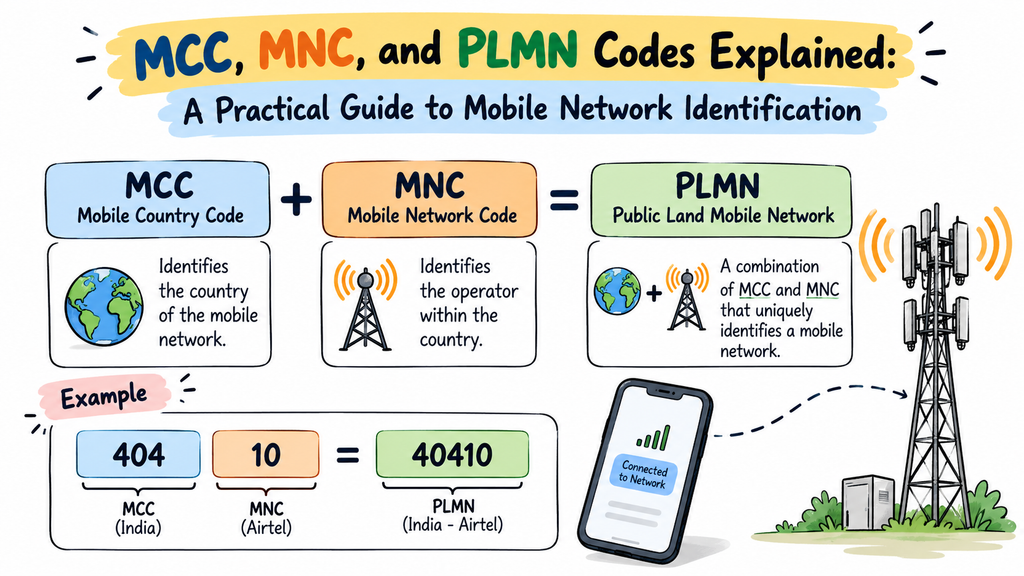
MCC stands for Mobile Country Code. It is a three-digit code used to identify a country or geographical numbering area within mobile network identification systems.
Mobile network identifiers use the MCC as part of their structure. Telecom databases and network systems rely on it to organize and interpret network information.
An MCC does not identify every detail about a mobile operator. It provides the country or geographical context for a network identifier. Readers should consult authoritative telecom references when they need to confirm a particular code assignment.
What Is an MNC?
MNC stands for Mobile Network Code. It identifies a mobile network within the context established by an MCC.
An MNC may contain two or three digits, depending on the applicable numbering plan. Readers should preserve the original format when recording or comparing codes.
An MNC alone may not provide enough information to identify a network correctly. Researchers generally need the associated MCC and reliable assignment information to interpret it accurately.
What Is a PLMN?
PLMN stands for Public Land Mobile Network. The term describes a public mobile network that provides services such as mobile voice or data connectivity.
In common network identification contexts, a PLMN identity combines an MCC and an MNC. Together, these codes help identify a particular mobile network within the relevant numbering system.
A PLMN identity is not the same as a consumer-facing mobile brand. One company may operate several brands, while a virtual operator may offer services using another operator’s network.
MCC vs. MNC vs. PLMN: Key Differences
These terms relate to one another, but they do not mean the same thing. The following table summarizes their main roles.
| Identifier | Full Name | Main Purpose | Typical Format | Important Limitation |
|---|---|---|---|---|
| MCC | Mobile Country Code | Identifies a country or geographical numbering area | Three digits | Does not identify the complete mobile operator by itself |
| MNC | Mobile Network Code | Identifies a network within an MCC context | Two or three digits, depending on the numbering plan | May be ambiguous without its associated MCC |
| PLMN | Public Land Mobile Network | Describes a public mobile network; its identity commonly combines MCC and MNC | MCC and MNC together | Does not prove coverage, roaming access, or service availability |
The key difference is scope. An MCC provides geographical context, an MNC identifies a network within that context, and a PLMN represents the public mobile network.
These identifiers help organize telecom information. They do not replace the operator’s service details, coverage information, or compatibility requirements.
How MCC, MNC, and PLMN Work Together
Mobile network identification depends on how systems interpret related codes. An MCC and an MNC form a common basis for identifying a network.
Consider a hypothetical example. A telecom database contains a three-digit MCC and a two-digit MNC. The database stores them as separate fields and associates them with an operator record.
A researcher can use the combined identifier to investigate the relevant network assignment. The researcher must still confirm the assignment through a suitable authoritative source.
A basic research workflow looks like this:
- Identify the MCC. Confirm the country or geographical context associated with the code.
- Identify the MNC. Check the network code within that context.
- Interpret the PLMN identity. Read the MCC and MNC together according to the relevant technical conventions.
- Check the operator record. Confirm the assignment through an authoritative source.
- Investigate the service relationship. Determine whether the name refers to a network operator, virtual operator, consumer brand, or reseller.
- Check service-specific requirements. Review coverage, roaming, device support, and eSIM requirements separately.
This process helps researchers avoid treating a code as proof of every service detail.
Why Mobile Network Codes Matter
MCC, MNC, and PLMN identifiers support several areas of telecommunications research and network operations.
Mobile Network Identification
Telecom systems need consistent identifiers to distinguish networks. MCC and MNC information helps systems interpret network identities within the relevant standards and configuration.
Correct identification matters when systems process network records, analyze mobile connectivity, or maintain operator databases.
Telecom Database Management
Telecom directories organize information about operators, network identifiers, and related entities. Accurate code records help users compare entries and investigate network assignments.
A useful directory should also explain its data structure. For example, it should distinguish the assigned network identifier from the operator’s public brand name.
Roaming Research
International roaming involves relationships among home operators, visited networks, and service providers. Network identifiers can help researchers investigate these relationships.
However, a matching MCC or MNC does not confirm that a customer can roam on a particular network. Commercial agreements, account settings, roaming policies, device support, and local service conditions can affect access.
eSIM Research
An eSIM lets a compatible device download and use a mobile subscription without inserting a removable SIM card. Users often research network operators when choosing an eSIM plan.
MCC and MNC information can help users understand the networks associated with a service. Still, the codes alone cannot establish which network an eSIM plan will use in every location.
Before buying a plan, users should check its supported countries, available networks, data allowance, activation conditions, and device requirements.
Telecom Analysis and Research
Analysts may use mobile network identifiers to organize records, investigate market structures, or compare operator information. These tasks require consistent data and careful source tracking.
Analysts should also distinguish network assignments from business relationships. A brand, reseller, and underlying network operator may have different roles even when they appear in the same connectivity journey.
Mobile Network Operators, Brands, MVNOs, and eSIM Providers
Telecom research becomes more complicated when companies use different business models. A company that sells mobile connectivity does not always own or operate the underlying radio network.
Understanding these distinctions helps readers interpret directory entries more accurately.
Mobile Network Operators
A mobile network operator, or MNO, operates mobile network infrastructure and provides mobile communication services under the applicable regulatory framework.
An operator may have assigned network identifiers associated with its network operations. Researchers should confirm the assignment and current status using authoritative records.
Mobile Virtual Network Operators
A mobile virtual network operator, or MVNO, sells mobile services without operating a complete independent radio access network of its own. It typically relies on infrastructure or wholesale services from another operator.
An MVNO may have its own customer service, pricing, branding, and subscription plans. Its relationship with the underlying network depends on its operating model and agreements.
Do not assume that every MVNO has a separate MCC/MNC assignment. The arrangement can vary.
Consumer Mobile Brands
A consumer brand is the name customers see when they purchase or use a service. The brand may belong to an infrastructure-owning operator or another company.
A brand name alone does not reveal the exact network identity that a device will use. Researchers should examine the underlying operator relationship rather than relying only on marketing names.
eSIM Providers and Resellers
Some eSIM providers sell connectivity plans that use networks operated by other companies. Their role may focus on plan selection, distribution, activation, or customer support.
An eSIM provider’s brand should not automatically be treated as the network operator. Users need to check the plan’s actual network arrangements and supported destinations.
| Entity Type | Main Role | What Researchers Should Verify |
|---|---|---|
| Mobile network operator | Operates mobile network infrastructure and services | Network assignment, operating entity, and service scope |
| MVNO | Offers mobile services using another operator’s infrastructure or wholesale access | Underlying network relationship and any separate network assignment |
| Consumer brand | Markets mobile services to customers | Company ownership and underlying operator |
| eSIM provider | Offers eSIM connectivity plans | Supported networks, destinations, plan terms, and provider role |
| Reseller | Distributes services supplied by another provider | Original service provider and relevant service conditions |
These categories can overlap in some business arrangements. A reliable directory should describe the relationship rather than assume every company fits one simple category.
How to Research MCC and MNC Assignments
Researchers should verify network identifiers before using them in reports, applications, or operational systems. Incorrect assignments can create confusion and lead to unreliable conclusions.
Follow this practical process.
Start With the Complete Identifier
Record the MCC and MNC as separate values. Preserve leading zeros and the original digit lengths.
For example, do not automatically convert a code stored as text into a number. Numeric conversion can remove leading zeros and change how the identifier appears.
Store the combined PLMN identity according to the applicable technical conventions. Keep the individual MCC and MNC fields available for validation.
Check an Authoritative Reference
Use the relevant national regulator, recognized standards documentation, or another authoritative telecom source to verify an assignment.
Choose a source that actually supports the question you need to answer. A regulator’s allocation record may establish a code assignment, but it may not confirm whether a commercial service currently operates or supports a particular roaming arrangement.
Record the source and the date you checked it. This helps future readers understand the basis of the information.
Confirm the Operator’s Identity
Compare the code assignment with the operator’s official name and available company information. Check whether the record describes a legal entity, operating company, brand, or service provider.
Do not merge two records just because their names look similar. Confirm the relationship before combining their data.
Investigate Conflicting Records
Different directories may show different names or details for what appears to be the same network. Such differences can arise from outdated records, naming variations, changes in company structure, or differences in the scope of the data.
Do not choose a record simply because it appears first in search results. Compare the sources, dates, definitions, and assignment details.
If the evidence remains unclear, mark the record as unverified rather than presenting a guess as fact.
Document the Result
A well-maintained record should include enough context for another person to understand how you identified the network.
Useful fields may include:
- MCC.
- MNC.
- Combined PLMN identity, where applicable.
- Operator name as reported by the source.
- Country or geographical context.
- Source of the assignment information.
- Verification date.
- Relevant notes about uncertainty or naming differences.
The exact fields depend on the directory’s purpose. Keep the structure consistent across records so users can compare them reliably.
Using a Telecom Directory for Network Research
A global telecom directory can help users explore network operators and related identifiers in one place. It can provide a starting point for research, especially when users need to compare records across countries.
eSIMGlobo focuses on researching mobile network operators, MCC, MNC, and PLMN identifiers. This subject area is relevant to telecom researchers, developers, travelers, and people exploring mobile connectivity options.
When using any directory, follow a few basic principles.
First, identify what the directory’s records represent. An entry may refer to a network assignment, a company, a consumer brand, or a connectivity provider. These are related, but they are not interchangeable.
Second, check the source and freshness of important data. Telecom assignments and commercial relationships can change, so historical information may not describe current services.
Third, use directory information as a research aid rather than final proof of service availability. Confirm important decisions with the relevant operator, provider, or authoritative source.
A directory is most useful when it helps users ask better questions and verify the answers.
Common Mistakes When Reading Mobile Network Codes
Even experienced researchers can misinterpret telecom records when they overlook code formats or business relationships.
Treating MCC as a Complete Network Identifier
An MCC supplies country or geographical context. It does not identify a specific mobile network by itself.
How to avoid the mistake: Check the associated MNC and the complete network record before identifying an operator.
Ignoring Leading Zeros
Some codes may begin with zero. Converting these values to ordinary numbers can remove important formatting information.
How to avoid the mistake: Store MCC and MNC values as text when appropriate. Preserve their original lengths and formatting.
Assuming Every Provider Owns a Network
An eSIM brand or MVNO may sell mobile connectivity without operating its own radio network.
How to avoid the mistake: Verify the company’s role and the underlying network relationship separately.
Treating a Code as Proof of Roaming Access
A valid network identifier does not guarantee that a customer can connect to that network.
How to avoid the mistake: Check roaming agreements, plan conditions, account eligibility, local availability, and device support.
Relying on an Undated Directory Entry
A directory entry may contain historical information or outdated company names.
How to avoid the mistake: Check the source date and verify material details before making operational or commercial decisions.
Confusing a Network Assignment With Live Service
An assigned identifier does not necessarily prove that a network currently offers a particular service in a particular location.
How to avoid the mistake: Confirm operational status and coverage through relevant current sources.
Important Considerations and Limitations
MCC, MNC, and PLMN identifiers are useful, but they answer only part of a larger set of telecom questions.
Assignments Can Change
Telecom regulators and operators may update assignments or related records. A directory that was accurate at one time may need revision later.
Researchers should track verification dates and revisit important records when the task depends on current information.
Names May Differ Across Sources
A regulator may use a legal entity name, while a consumer website uses a familiar brand. A telecom database may use another standardized name.
These differences do not automatically indicate an error. Researchers need to establish what each source identifies.
Identifiers Do Not Confirm Compatibility
A device may support some network technologies or frequency bands but not others. An eSIM plan may also have destination-specific restrictions.
An MCC/MNC record alone cannot confirm whether a device or subscription will work. Users should review the device specifications and provider terms.
Network Identity Does Not Guarantee Coverage
A network may have an assigned identity but limited coverage in a particular area. Service quality can also vary with location, congestion, network technology, and local conditions.
Users should check current coverage information when they need connectivity in a specific place.
Historical and Current Records Serve Different Purposes
Historical records can help researchers understand earlier assignments or changes in company structure. They should not automatically use those records to describe current services.
Keep historical and current information separate whenever the distinction matters.
Frequently Asked Questions
1. What does MCC mean in telecommunications?
MCC means Mobile Country Code. It is a three-digit identifier that provides country or geographical context within mobile network identification systems. It works with other network information to help identify a mobile network.
2. What does MNC stand for?
MNC stands for Mobile Network Code. It identifies a mobile network within an MCC context. Depending on the applicable numbering plan, an MNC may contain two or three digits.
3. What is a PLMN code?
PLMN stands for Public Land Mobile Network. In common network identification contexts, the PLMN identity combines an MCC and an MNC. It helps identify a public mobile network but does not establish every detail about its services.
4. What is the difference between MCC and MNC?
An MCC provides country or geographical context, while an MNC identifies a network within that context. Researchers generally need both values to interpret a network identity correctly.
5. Does every mobile operator have its own MNC?
Do not assume that every brand or service provider has a separate MNC. Assignments depend on the relevant numbering arrangements and the entity’s role. Verify the specific operator or provider through authoritative records.
6. Are MCC and MNC codes enough to confirm roaming access?
No. These identifiers can help identify networks, but they do not prove roaming eligibility. Access may depend on commercial agreements, plan restrictions, account settings, device support, and local service conditions.
7. Can I use MCC and MNC information to choose an eSIM plan?
You can use the information as one part of your research. However, you should also check supported destinations, available networks, data allowances, activation rules, and device compatibility before choosing a plan.
8. Why do telecom directories sometimes show different operator names?
Directories may use different naming conventions or reflect different dates and data sources. One source might list a legal entity, while another lists a consumer brand. Compare the source, scope, and verification date before deciding which record applies.
9. Why should I preserve leading zeros in network codes?
Leading zeros can form part of an identifier’s correct representation. Converting a code to a number may remove those zeros and cause data-matching problems. Store identifiers in a format that preserves their original digits.
10. How can I verify an MCC or MNC assignment?
Check the relevant national regulator, recognized standards documentation, or another authoritative telecom reference. Record the source and verification date, then compare the assignment with the operator’s official information when needed.
Conclusion
MCC, MNC, and PLMN identifiers provide a structured way to understand mobile network identities. Each has a distinct role, and researchers get the clearest results when they interpret these codes together.
Accurate telecom research also requires more than reading a code. Users should confirm assignments, preserve the correct format, distinguish operators from brands and resellers, and verify service conditions separately. These steps reduce errors and help keep telecom records useful.
For anyone exploring global mobile network information, a directory such as eSIMGlobo can provide a starting point for research. The most reliable decisions come from combining directory information with authoritative records and current service details.
