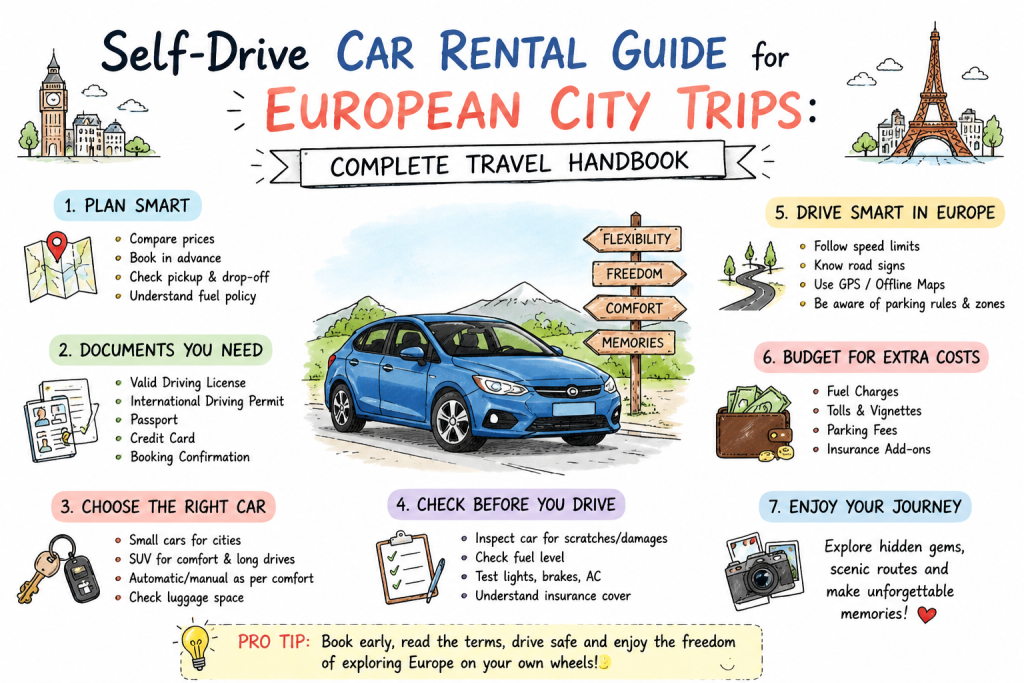
Introduction
A self-drive car rental in Europe can turn an ordinary city holiday into a flexible and memorable travel experience. Instead of depending entirely on train schedules, expensive taxis, or organised tours, you can travel at your own pace, stop in smaller towns, carry luggage conveniently, and explore attractions outside major city centres.
However, driving in Europe requires careful preparation. Traffic rules, parking systems, toll roads, environmental zones, licence requirements, fuel policies, and insurance conditions can change from one country to another. A rental arrangement that works well in Portugal may not be suitable for a trip through France, Germany, Italy, or Switzerland.
For Indian tourists, the experience may also involve adjusting to right-hand traffic, unfamiliar road signs, automated parking systems, narrow historic streets, and strict speed enforcement. Choosing the right vehicle and understanding the rental agreement can prevent unnecessary costs and travel stress.
This self-drive car rental guide for European city trips explains how to choose a vehicle, prepare the required documents, estimate rental costs, understand insurance, avoid common mistakes, and decide when a car is better than public transport. It also explains how motorcycles and scooters available through MotoShare Europe can provide an alternative for suitable city trips and scenic routes.
Why Choose a Self-Drive Rental for European City Trips?
Europe has one of the world’s most extensive public transportation networks, but public transport does not suit every itinerary. Trains and buses are excellent for travelling between major city centres, while a rental vehicle becomes more valuable when your plans include rural areas, small towns, coastal routes, mountain regions, or several attractions in one day.
Greater Travel Flexibility
A self-drive rental allows you to decide:
- When to leave
- Where to stop
- How long to stay at each destination
- Which route to take
- Whether to change your itinerary
- How much luggage to carry
For example, a traveller staying in Munich can use public transport within the city but rent a car for a day trip to the Bavarian countryside. Similarly, visitors to Lisbon may rent a vehicle for Sintra, Cascais, or nearby coastal areas rather than use it throughout central Lisbon.
Easier Access to Smaller Destinations
Many European villages, castles, vineyards, lakes, beaches, and countryside attractions are not directly connected by frequent public transport. A rental car can reduce transfers and make remote destinations easier to reach.
Popular examples include:
- Tuscan villages outside Florence
- Coastal towns near Barcelona
- The Scottish Highlands
- Villages in Provence
- Lakes and mountain areas around Zurich
- Small towns in Austria
- Croatia’s coastal routes
- Rural areas of Ireland
Better for Groups and Families
When three or four people travel together, the combined cost of train tickets, airport transfers, and local taxis may be comparable to renting a small car. A rental can also make it easier to manage children, luggage, shopping bags, and flexible meal stops.
However, travelers must include fuel, parking, tolls, insurance, and possible cross-border charges when comparing the total cost.
Who Should Rent a Car in Europe?
A self-drive car rental is particularly useful for:
Families
Families carrying luggage, child seats, food, and travel equipment may find a private car more comfortable than changing trains or buses several times.
Groups of Friends
A group can divide the rental, fuel, toll, and parking expenses. This can make a car reasonably affordable, especially for day trips outside city centres.
Business Travelers
Working professionals visiting industrial areas, client offices, conference venues, or suburban locations may save time by renting a vehicle.
Backpackers Exploring Rural Areas
Backpackers often use trains between major cities. However, renting a small car for a few days can help them explore national parks, villages, coastlines, and countryside areas.
Couples Planning Scenic Drives
Routes through the Alps, the Mediterranean coast, Tuscany, Scotland, Ireland, or the Balkans can be more enjoyable with a self-drive vehicle.
Travelers with Limited Mobility
A rental car may offer greater comfort and accessibility than walking long distances or frequently changing public transport.
When You May Not Need a Rental Car
Renting a car is not always the best option for a European city holiday.
You may not need one when:
- Your entire stay is inside a major city centre
- The city has reliable metro, tram, and bus services
- Your hotel does not provide parking
- You are uncomfortable driving on unfamiliar roads
- You plan to consume alcohol during outings
- Your itinerary connects only major cities by high-speed train
- Historic areas restrict private vehicle access
- Daily parking costs are high
Cities such as Paris, Amsterdam, London, Vienna, Madrid, Barcelona, Berlin, Rome, and Prague generally have extensive public transportation. A practical strategy is to use public transport within the city and rent a vehicle only for selected day trips.
Types of Cars You Can Rent in Europe
Choosing the right vehicle can significantly affect your comfort, parking convenience, fuel cost, and overall rental price.
Mini Cars
Mini cars are among the easiest vehicles to use in European cities. They are suitable for one or two travelers with limited luggage.
Best for:
- Short city trips
- Budget travelers
- Narrow streets
- Limited parking spaces
- Light luggage
Their small size makes them practical in historic areas, but they may feel uncomfortable on long motorway journeys.
Economy Hatchbacks
Economy hatchbacks provide a balance of affordability, luggage space, and fuel efficiency. They are suitable for couples, small families, and city-to-city travel.
Best for:
- Two or three passengers
- Urban and motorway driving
- Moderate luggage
- Budget-conscious travelers
- Multi-day rentals
Compact Sedans
Compact sedans generally offer more luggage space and comfort than mini cars. They are useful for longer journeys but may be less convenient in very narrow streets.
SUVs and Crossovers
SUVs provide more luggage capacity and a higher driving position. However, they usually cost more to rent, consume more fuel, and can be difficult to park in old European city centres.
Best for:
- Families
- Mountain destinations
- Long-distance routes
- Travelers carrying several bags
- Winter travel where suitable equipment is provided
Estate Cars
Estate cars are useful for groups needing substantial luggage space without renting a large SUV. They are common in Europe and well suited to longer road trips.
Luxury Cars
Luxury rentals are available in many major cities but may involve high deposits, stricter age requirements, larger insurance excesses, and expensive damage charges.
Electric Cars
Electric cars can be suitable for city travel and regions with reliable charging infrastructure. Before booking, examine:
- Expected driving range
- Charging-station availability
- Charging-card requirements
- Hotel charging facilities
- Return-charge policy
- Cross-border charging compatibility
An electric rental may be less convenient when visiting remote areas without advance route planning.
Automatic Cars
Manual-transmission vehicles remain common in many European rental fleets. Indian travelers who are not comfortable using a manual car should specifically book an automatic vehicle.
Automatic cars are often more expensive and may have limited availability during busy travel periods. Book early rather than assuming an automatic model will be available at the rental counter.
How to Choose the Right Rental Car
Consider the Number of Travelers
A small car may appear affordable, but it can become uncomfortable when four adults and several suitcases are included. Check both passenger capacity and luggage capacity.
Review Your Route
For narrow city streets and short trips, choose a mini or economy vehicle. For long motorway journeys, consider a compact sedan, estate car, or comfortable crossover.
Check the Transmission
Always confirm whether the car has manual or automatic transmission. Do not rely only on the vehicle photograph.
Compare Total Cost, Not Only the Base Rate
The advertised daily price may exclude:
- Insurance upgrades
- Young-driver fees
- Additional-driver fees
- Airport surcharges
- One-way rental fees
- Cross-border charges
- Child-seat charges
- Navigation equipment
- Winter equipment
- Fuel costs
- Toll charges
- Parking fees
Compare the estimated final amount before choosing a rental.
Think About Parking
Small vehicles are usually easier to park in Europe. Many underground car parks have tight entrances, narrow spaces, and low height limits.
Choose a Suitable Fuel Type
Petrol vehicles are convenient for shorter trips. Diesel vehicles may be economical for long distances, although access restrictions may affect certain older vehicles. Electric cars work best when charging has been planned carefully.
Documents Usually Needed to Rent a Car in Europe
Exact requirements depend on the rental company and destination country.
Valid Driving Licence
You need a full, valid driving licence accepted by the rental company and the country where you will drive. Some rental companies also require the licence to have been held for a minimum period.
Indian travelers should carry their original Indian driving licence. A photocopy or digital image may not be accepted.
International Driving Permit
An International Driving Permit may be required or strongly recommended when the original licence was issued outside Europe or is not in the locally accepted format.
An IDP does not replace the original driving licence. Travelers normally need to carry both documents.
Requirements differ by country, so verify the rules for every country included in your itinerary.
Passport
International tourists generally need to show a valid passport during vehicle collection.
Visa or Entry Documentation
Rental providers may ask for evidence of legal entry or travel details, although practices differ.
Credit Card
Many traditional rental companies require a physical credit card in the main driver’s name. The card is used to block a security deposit.
Debit cards, prepaid cards, virtual cards, and cards belonging to another traveler may not be accepted.
Booking Confirmation
Carry a digital or printed copy of your booking confirmation, including:
- Rental dates
- Vehicle category
- Pickup location
- Drop-off location
- Included mileage
- Insurance details
- Agreed price
- Additional services
Address Information
The company may ask for your home address, hotel address, flight information, or contact number.
Understanding Rental Age Requirements
Minimum rental age depends on the country, vehicle category, and rental company. Some companies accept younger drivers but charge an additional fee.
Premium, luxury, high-performance, and large vehicles may have higher minimum-age requirements. Drivers below a specified age may face:
- Young-driver charges
- Limited vehicle selection
- Higher deposits
- Larger insurance excesses
- Restrictions on cross-border travel
Drivers should enter their correct age during the online search to receive a more accurate price.
What to Check Before Accepting the Car
Inspect the Vehicle Carefully
Walk around the car and check for:
- Scratches
- Dents
- Cracked lights
- Windscreen damage
- Damaged wheels
- Tyre problems
- Interior stains
- Missing equipment
Take clear photographs and videos before leaving the pickup location. Ensure all existing damage is recorded in the rental inspection report.
Check the Fuel or Charging Level
Confirm whether the rental follows:
- Full-to-full fuel policy
- Same-to-same policy
- Prepaid fuel policy
- Electric return-charge requirement
Full-to-full is often the easiest policy to understand. Return the vehicle with the required fuel level and retain the receipt.
Understand the Mileage Allowance
Some rentals include unlimited mileage, while others set a daily or total limit. Excess mileage can significantly increase the final bill.
Review Insurance Coverage
Understand the difference between basic liability coverage, collision-related protection, theft protection, personal accident coverage, roadside assistance, and optional excess reduction.
Pay particular attention to exclusions involving:
- Tyres
- Windscreens
- Wheels
- Roof damage
- Underbody damage
- Lost keys
- Incorrect fuel
- Negligent driving
- Unauthorised drivers
- Restricted roads
Confirm Emergency Equipment
Depending on the destination, the vehicle may need safety equipment such as a reflective vest, warning triangle, first-aid kit, or winter equipment.
Test Important Controls
Before driving away, locate and test:
- Headlights
- Indicators
- Wipers
- Hazard lights
- Parking brake
- Navigation system
- Air conditioning
- Mirror controls
- Fuel-cap release
- Charging cable where applicable
Ask About Breakdown Procedures
Save the rental company’s roadside-assistance number. Ask what steps to follow after a breakdown, collision, puncture, theft, or warning light.
Insurance and Security Deposits
Rental insurance can be one of the most confusing parts of booking.
Basic Insurance
The base rental rate may include certain legally required or standard protections, but this does not necessarily remove the renter’s financial responsibility.
Collision Damage Protection
Collision damage protection may limit the amount payable after accidental vehicle damage. However, it commonly includes an excess or deductible.
For example, if the excess is €1,000, the renter may remain responsible for costs up to that amount, subject to the contract.
Theft Protection
This may reduce liability if the car is stolen, but exclusions and excess amounts can apply.
Excess Reduction
Rental companies may offer additional protection that reduces the excess. Review the cost against your risk tolerance and existing travel insurance.
Third-Party Insurance
Some credit cards and travel insurance policies offer rental-car protection. Read the conditions carefully because they may require the renter to pay the rental company first and seek reimbursement later.
Security Deposit
The deposit may be temporarily blocked on the main driver’s card. The amount depends on the vehicle, insurance package, rental company, and location.
Make sure the card has enough available credit for both the deposit and your travel spending.
European Driving Rules Indian Travelers Should Understand
Driving Side
Most European countries drive on the right side of the road. The United Kingdom, Ireland, Malta, and Cyprus drive on the left.
Indian drivers may find left-side driving more familiar, but road layouts and rules will still differ.
Speed Limits
Speed limits vary by road type and country. Follow posted signs rather than assuming one standard applies throughout Europe.
Automated speed enforcement is common, and rental companies may charge an administrative fee when forwarding traffic penalties.
Seat Belts
All occupants should wear seat belts. Children may require approved child-restraint systems based on their age, height, or weight.
Mobile Phones
Do not hold or use a mobile phone while driving. Use an approved hands-free arrangement and set navigation before starting the journey.
Alcohol Limits
Legal alcohol limits differ between countries and may be lower for new or professional drivers. The safest approach is not to drink alcohol when you plan to drive.
Roundabouts
At many European roundabouts, vehicles already circulating have priority, but road signs and markings must always be followed.
Pedestrians and Cyclists
European cities often have extensive pedestrian crossings, cycle lanes, and tram corridors. Check mirrors carefully before turning or opening doors.
Emergency Vehicles
Drivers may need to create space for emergency vehicles using methods that differ by country. Learn the local procedure before travelling.
Low-Emission Zones and Restricted City Areas
Many European cities regulate vehicle access to reduce pollution and congestion. Restrictions may depend on:
- Vehicle emission category
- Fuel type
- Registration status
- Time of day
- Street or district
- Resident permits
- Congestion charges
- Environmental stickers
Some historic centres use camera-controlled restricted zones. Entering without permission may result in penalties, even when your navigation system directs you through the area.
Ask the rental provider whether the vehicle:
- Is eligible to enter your planned destinations
- Has required environmental registration or stickers
- Is subject to congestion charges
- Can be driven into restricted historic districts
When possible, park outside the restricted centre and continue by metro, tram, bus, bicycle, or on foot.
Tolls, Vignettes, and Road Charges
European road-payment systems differ by country.
You may encounter:
- Toll booths
- Electronic toll systems
- Distance-based tolls
- Motorway vignettes
- Congestion charges
- Tunnel charges
- Bridge charges
- Ferry fees
- Low-emission zone fees
Ask whether the rental includes an electronic toll device. Understand how charges will be billed and whether administrative fees apply.
When crossing borders, confirm whether a vignette must be purchased. Never assume the vehicle already has every permit needed for all countries.
Parking in European Cities
Parking is often the greatest challenge of renting a car in a European city.
Understand Parking Zones
Street-parking rules may vary by colour, district, time, vehicle type, and resident status. Read every sign before leaving the car.
Use Official Parking Facilities
Underground garages and park-and-ride facilities may cost more than distant street parking but can reduce the risk of fines, towing, or restricted-zone violations.
Check Hotel Parking
Before booking accommodation, ask:
- Is parking available?
- Is advance reservation required?
- What is the daily price?
- Is there a height restriction?
- Is the car park inside a restricted zone?
- Can guests enter without a local permit?
Never Leave Valuables Visible
Remove passports, electronics, luggage, wallets, and shopping bags from visible areas. Use secure hotel storage whenever possible.
Estimated Cost of Renting a Car in Europe
Rental prices vary significantly according to city, season, booking date, driver age, transmission, demand, insurance, and vehicle availability.
The following broad daily estimates are for planning only:
| Vehicle Category | Approximate Base Rental Range Per Day | Suitable For |
|---|---|---|
| Mini car | €25–€60 | Solo travelers and couples |
| Economy car | €30–€75 | Budget city trips |
| Compact car | €40–€90 | Small families and longer drives |
| Estate car | €55–€120 | Groups with luggage |
| SUV or crossover | €60–€150 | Families and countryside routes |
| Premium vehicle | €100–€300 or more | Luxury and business travel |
| Electric vehicle | €40–€130 | Planned city and regional travel |
The final cost may also include fuel, charging, parking, tolls, insurance upgrades, deposits, young-driver charges, child seats, and cross-border fees.
Booking early usually provides a wider choice, especially for automatic vehicles during summer and holiday periods.
Self-Drive Car vs Public Transport vs Taxi
| Factor | Self-Drive Car | Public Transport | Taxi or Ride-Hailing |
| Cost | Good value for groups but includes parking, fuel and tolls | Usually economical for city-centre travel | Can become expensive for repeated or long journeys |
| Convenience | High for luggage, families and remote areas | High on well-connected routes | Door-to-door convenience |
| Flexibility | Excellent route and schedule control | Limited by routes and timetables | Flexible but dependent on availability |
| Comfort | Private space and luggage storage | Can become crowded | Comfortable for short trips |
| Parking | Driver must find and pay for parking | No parking required | No parking responsibility |
| Rural Access | Strong option for villages and countryside | May be limited | Possible but expensive |
| City-Centre Use | Can be difficult due to traffic and restrictions | Usually the best choice | Useful for occasional trips |
| Travel Experience | Ideal for scenic drives and spontaneous stops | Relaxing and efficient between major cities | Best for direct transfers |
| Best Use Cases | Families, groups, road trips and regional exploration | Major cities and intercity routes | Airports, hotels and late-night transport |
A combined approach often works best: use public transport in city centres and rent a car for regional day trips.
Safety Tips for Driving a Rental Car in Europe
Learn Local Rules Before Driving
Review the official road rules for every country on your route. Do not assume neighbouring countries follow identical regulations.
Avoid Driving Immediately After a Long Flight
Jet lag, unfamiliar roads, and a different driving side can increase risk. Rest before beginning a long journey.
Use Offline Navigation
Download maps before the trip. Mobile coverage may be weak in tunnels, mountains, or rural areas.
Plan Parking Before Arrival
Search for an official car park before entering a busy city centre. This can help you avoid restricted zones and narrow streets.
Keep Emergency Information Available
Save:
- Rental-company assistance number
- Local emergency number
- Insurance contact information
- Hotel contact details
- Booking reference
- Vehicle registration information
Adjust for Weather
Rain, snow, fog, ice, and mountain conditions can affect driving. Confirm whether winter tyres, snow chains, or other seasonal equipment are required.
Take Regular Breaks
Stop regularly during long motorway journeys. Do not create an unrealistic itinerary involving several cities in a single day.
Cross-Border Car Rental Rules
Cross-border driving is common in Europe, but it is not automatically permitted with every rental.
Before booking, confirm:
- Which countries are allowed
- Whether advance permission is required
- Whether a cross-border fee applies
- Whether insurance remains valid
- Whether roadside assistance works abroad
- Whether ferries are permitted
- Whether the car can enter non-EU countries
- Whether different winter equipment is needed
Do not take the vehicle into an unapproved country. Doing so may violate the agreement and affect insurance coverage.
One-Way Rentals
A one-way rental allows you to collect the car in one location and return it elsewhere.
This can be convenient for trips such as:
- Paris to Nice
- Madrid to Barcelona
- Lisbon to Porto
- Milan to Rome
- Munich to Frankfurt
However, domestic and international one-way fees can be expensive. Returning a vehicle in another country may cost considerably more than returning it within the same country.
Compare the one-way fee with the cost of returning by train or adjusting your itinerary.
Common Mistakes First-Time Renters Should Avoid
Choosing the Cheapest Advertised Price
A low base rate may become expensive after insurance, deposits, mileage limits, and additional services are included.
Forgetting to Book an Automatic
Travelers accustomed to automatic cars may accidentally reserve a manual vehicle.
Ignoring Credit Card Requirements
Arriving without an accepted card in the main driver’s name may result in refusal, a costly insurance upgrade, or cancellation.
Skipping the Vehicle Inspection
Without photos and a signed condition report, proving that damage already existed may be difficult.
Entering Restricted Zones
Navigation apps do not always account for permit-controlled streets or historic-city restrictions.
Returning the Car Late
Even a relatively short delay may trigger extra charges under the rental agreement.
Returning with the Wrong Fuel Level
Check the fuel policy and keep the final refuelling receipt.
Allowing an Unregistered Person to Drive
Only drivers listed in the agreement should operate the vehicle.
Assuming Unlimited Mileage
Read the mileage conditions before planning long regional journeys.
Crossing Borders Without Permission
Obtain written approval and confirm insurance coverage before entering another country.
Motorcycles and Scooters as an Alternative
A car is not the only self-drive option for European travel. Motorcycles and scooters can be practical for experienced, appropriately licensed riders who want a more direct and engaging travel experience.
A motorcycle may be suitable for:
- Scenic countryside routes
- Coastal roads
- Weekend rides
- Solo travel
- Short regional trips
- Travelers carrying limited luggage
However, riders must consider weather, safety equipment, licence category, insurance, luggage capacity, parking rules, and city restrictions.
MotoShare Europe connects renters with motorcycles offered by private owners and affiliated providers in supported markets. Travelers can browse available models, compare rental terms, review applicable insurance information, and select a vehicle suited to their riding experience.
Motorcycles should not be treated as a substitute for a car when transporting children, several passengers, large luggage, or travelers unfamiliar with European road conditions.
How MotoShare Europe Can Support Your Journey
MotoShare Europe can help eligible riders explore motorcycle rental opportunities through a peer-to-peer rental model.
Online Vehicle Search
Travelers can search for motorcycles based on destination, date, availability, and vehicle type.
Range of Motorcycle Options
Depending on local availability, renters may find touring bikes, road motorcycles, adventure models, cruisers, and other two-wheelers.
Direct Rental Information
Listings allow travelers to review the vehicle, rental conditions, owner requirements, and applicable terms before confirming a booking.
Community-Based Rental Model
The platform connects motorcycle owners with qualified renters, giving travelers access to privately owned vehicles and participating providers.
Insurance Information
MotoShare publishes information about insurance protection during eligible rentals. Renters should still read the exact policy, excess, exclusions, territorial limits, and eligibility requirements for their booking.
Flexible European Travel
A rented motorcycle can support day rides, weekend journeys, regional touring, and scenic route exploration.
Before booking, verify that your driving licence covers the selected motorcycle category and is valid in every country on your route.
Frequently Asked Questions
1- Can Indian tourists rent a car in Europe?
Yes, Indian tourists can generally rent cars in European destinations when they meet the rental company’s age, licence, identification, payment-card, and experience requirements. Carry your original Indian driving licence, passport, booking confirmation, and any required International Driving Permit. Requirements must be checked for the specific destination country and provider.
2- Is an International Driving Permit required in Europe?
It depends on the country, your licence format, and the rental company. Some destinations require an IDP for non-European licences, while others may accept an original licence containing recognised information. Carrying an IDP alongside the original Indian licence is often a sensible precaution, but it never replaces the original licence.
3- Can I drive a rental car across several European countries?
Possibly, but you need the rental company’s permission. Cross-border restrictions, fees, insurance conditions, roadside-assistance coverage, and country exclusions may apply. Provide your complete route before booking and obtain written confirmation.
4- How much does a self-drive car rental in Europe cost?
A small car may start from approximately €25 to €60 per day, while larger or automatic vehicles can cost considerably more. Season, location, booking time, driver age, insurance, transmission, and demand affect pricing. Always calculate parking, fuel, tolls, deposits, and additional fees.
5- Is it better to rent a car or use trains in Europe?
Trains are usually more convenient for travel between major city centres. A rental car is better for villages, countryside areas, family travel, scenic routes, and destinations with limited transport. Many travelers use trains for major cities and rent a car for selected regional trips.
6- Are automatic rental cars available?
Yes, but manual cars are common and automatics may cost more. Automatic vehicles can sell out during busy periods, so select the transmission carefully and book early.
7- Is rental-car insurance included?
Some basic protection may be included, but you may still have a large excess or deductible. Read the policy carefully and review exclusions for tyres, windscreens, keys, roof, underbody, and unauthorised use.
8- Can I rent a car without a credit card?
Some providers accept debit cards, but many require a physical credit card in the main driver’s name for the security deposit. Check the payment policy before booking. Do not assume a virtual or prepaid card will be accepted.
9- What happens if the rental car breaks down?
Park safely, activate the hazard lights, follow local safety procedures, and call the rental company’s roadside-assistance service. Do not arrange repairs independently unless the company authorises them. Keep all receipts and records.
10- Can I take a rental car into a low-emission zone?
Only when the vehicle meets the city’s requirements and has any necessary registration or permit. Ask the provider whether the car is authorised for your destination. Camera-controlled zones may issue penalties automatically.
11- Can another traveler drive the rental car?
Only when that person is registered as an additional driver and meets the company’s requirements. Allowing an unauthorised person to drive may violate the agreement and affect insurance coverage.
12- Are child seats available?
Most established rental providers offer child seats for an additional charge, subject to availability. Reserve the appropriate seat in advance and confirm that it complies with local rules.
13- Can I rent a motorcycle through MotoShare Europe?
Eligible riders can search MotoShare Europe for motorcycles available in supported locations. Availability, licence conditions, age requirements, insurance, deposits, and rental terms depend on the listing and destination.
14- Should I rent a car for an entire European city holiday?
Not necessarily. Keeping a car inside a major city can create unnecessary parking expenses and restricted-zone risks. Consider collecting the vehicle only when leaving the city for regional destinations.
Conclusion
A self-drive car rental in Europe provides freedom, convenience, and access to destinations that are difficult to explore using public transport alone. It can be especially valuable for families, small groups, countryside holidays, coastal routes, and multi-stop regional journeys.
Successful rental travel depends on preparation. Choose a vehicle that matches your route, luggage, transmission preference, and passenger requirements. Confirm your licence validity, International Driving Permit requirements, insurance, security deposit, mileage allowance, fuel policy, cross-border permission, toll arrangements, and parking options before collecting the car.
For major European city centres, public transport may remain the easier choice. A balanced itinerary can include trains and metros for urban travel, a rental car for countryside excursions, and a motorcycle for qualified riders seeking scenic two-wheel adventures.
Explore rental opportunities through MotoShare Europe at motoshare.eu, review the applicable vehicle and insurance conditions, and plan a flexible European journey that matches your budget, experience, and travel style.
