Introduction
Renting a car is a convenient way to explore new places, travel with family, and enjoy road trips. It gives you more freedom than public transport. You can also plan your journey according to your own schedule.
However, renting a car requires some preparation. First-time renters may overlook important details such as insurance, vehicle condition, fuel policies, and hidden charges. These small mistakes can lead to unexpected expenses and travel problems.
Whether you are planning a weekend trip to Goa, a family holiday in Jaipur, or a business visit to Mumbai, choosing the right rental car matters.
India offers several transportation options, including self-drive cars, chauffeur-driven vehicles, rental bikes, and scooters. Each option serves different travel needs.
Before confirming your booking, take time to understand the rental conditions. Inspect the vehicle carefully and read the agreement. These simple steps can help you avoid unnecessary trouble.
In this guide, we explain the important things to check before renting a car in India. We also cover rental documents, insurance, vehicle prices, safety tips, and common mistakes.
2. Why Renting a Car in India Is a Smart Choice
India has many destinations that are easier to explore with a private vehicle. Public transport works well in many cities, but it may not reach every tourist attraction.
A rental car gives travelers more control over their journeys.
Freedom to Travel at Your Own Pace
You do not need to follow fixed bus or train schedules. You can stop for photographs, food, shopping, or sightseeing whenever you want.
For example, travelers visiting Jaipur can explore Amer Fort, Nahargarh Fort, and other attractions at their own pace.
Convenient Family Travel
A rental car offers a comfortable option for families with children or older members. You can carry luggage, shopping bags, and travel essentials more easily.
Better Options for Road Trips
Some destinations offer beautiful road journeys. A rental car can make trips between Bangalore and Mysore or Mumbai and Lonavala more convenient.
Privacy and Comfort
A private vehicle gives you personal space during your journey. It can also help when you need to attend work calls or travel with family.
Flexible Travel Plans
You can change your route based on weather, traffic, or personal interests. This flexibility makes car rental useful for tourists and working professionals.
3. Who Should Rent a Car in India?
Car rentals can suit different types of travelers. Your travel plans, group size, and budget will help you decide.
First-Time Travelers
Visitors who are unfamiliar with a city may prefer a rental car for comfortable travel. However, they should understand local traffic rules before driving.
Tourists and Vacationers
Tourists visiting Delhi, Goa, Mumbai, or Chennai can use rental cars to explore different attractions.
Families
Families often need extra space for passengers and luggage. A sedan, SUV, or larger vehicle may offer better comfort.
Working Professionals
Business travelers can rent cars for airport transfers, meetings, and city travel.
Students and Budget Travelers
Students may find short-term car rentals useful for group outings. Sharing the rental cost among passengers can make the journey more affordable.
Weekend Road Trip Travelers
Travelers planning short trips can rent a vehicle without buying one. They can choose a suitable car for each journey.
4. Benefits of Renting a Car for First-Time Travelers
First-time travelers may feel unsure about renting a vehicle. Understanding the benefits can help them make a better decision.
1. Easy trip planning: You can decide your departure time and travel route.
2. Comfortable transportation: Air conditioning and private seating can make long journeys easier.
3. Luggage space: Rental cars provide more storage than most two-wheelers.
4. Group travel: Friends and families can travel together in one vehicle.
5. Access to more attractions: A suitable car can help you reach places with limited public transport.
6. Flexible booking periods: Depending on the provider, you may find hourly, daily, or weekly rental options.
However, always compare the total rental cost before booking. A low starting price does not always mean a cheaper trip.
5. Types of Rental Vehicles Available in India
Before booking, understand the different vehicle categories. The right choice depends on your route, passenger count, and budget.
Hatchback Cars
Hatchbacks are suitable for city travel and short journeys. They are generally easier to park in crowded areas.
They can work well for small groups and budget-conscious travelers.
Sedan Cars
Sedans offer more cabin space and a separate luggage compartment. They are suitable for business trips and family journeys.
They can be a good option for routes between Delhi, Jaipur, and Agra.
SUVs
SUVs offer more passenger space and higher ground clearance. Some models are suitable for rougher roads.
They can be useful for family holidays and longer road trips. However, check the vehicle’s actual road suitability before booking.
Premium Cars
Premium cars offer additional comfort and features. They may suit special occasions, business meetings, and luxury travel.
Their rental charges and security deposits may be higher.
Electric Cars
Electric cars can help reduce fuel expenses. However, you should check charging stations along your planned route.
Also, understand the vehicle’s driving range and charging rules before booking.
Rental Bikes and Scooters
Cars are not always the best choice for every journey. Bikes and scooters can be more convenient for short city trips.
For example, travelers can use scooters to explore Goa or motorcycles to enjoy suitable scenic routes around Pune.
A bike rental in India can also reduce parking difficulties and offer more flexibility for solo travelers.
6. How to Choose the Right Rental Vehicle for Your Trip
Choosing the right vehicle can improve your travel experience. Consider these factors before booking.
Check the Number of Passengers
Choose a vehicle that comfortably accommodates everyone. Do not select a small car for a large group.
Consider Your Travel Distance
A compact car may work for short city trips. A comfortable sedan or SUV may suit longer journeys.
Understand Road Conditions
Some roads may have potholes, steep slopes, or narrow sections. Choose a vehicle that suits your route.
For example, an SUV may be useful for certain mountain routes. However, always follow local road restrictions.
Compare Luggage Capacity
Check whether the boot can hold your bags. This is especially important for airport pickups and family holidays.
Check Fuel Efficiency
A fuel-efficient vehicle can help reduce your overall travel expenses.
Review Available Features
Check important features such as:
- Air conditioning
- Working seat belts
- Parking sensors or cameras
- GPS or navigation support
- Spare tyre
- First-aid kit
Do not pay extra for features you do not need.
7. Documents Usually Needed to Rent a Car in India
Rental providers usually ask for documents to verify your identity and driving eligibility.
Requirements may vary between providers.
Valid Driving Licence
A valid driving licence is essential for self-drive car rentals. Make sure it covers the vehicle category you plan to drive.
International visitors should check whether their licence is accepted in India.
Government ID Proof
Providers may request identity documents such as:
- Aadhaar card
- Passport
- Voter ID
- Other accepted government identification
Foreign tourists may need to provide their passport and visa details.
Address Proof
Some rental providers may request address verification. Check the accepted documents before booking.
International Driving Permit
Foreign visitors should confirm whether they need an International Driving Permit (IDP).
An IDP may be required alongside the original driving licence, depending on the visitor’s country and applicable Indian rules.
Do not assume that a foreign driving licence alone will always be accepted.
Security Deposit Requirements
Many rental providers collect a refundable security deposit.
Before paying, confirm:
- Deposit amount
- Payment method
- Refund conditions
- Possible deductions
- Expected refund timeline
Always request a payment receipt.
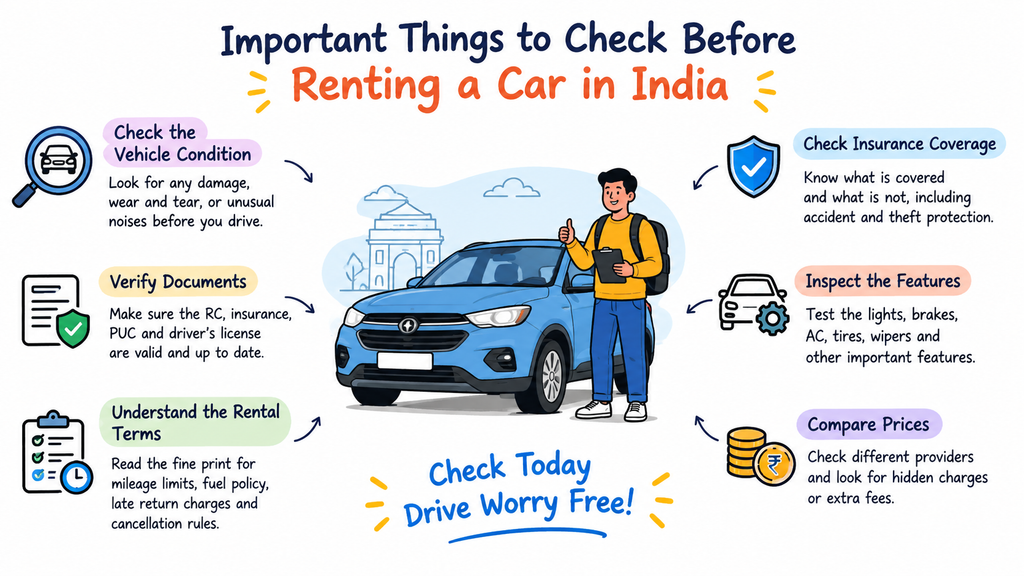
8. Important Things to Check Before Renting a Car
This is one of the most important steps in the rental process. A careful inspection can help prevent disputes and unexpected costs.
Vehicle Condition
Inspect the vehicle before accepting it.
Check:
- Scratches and dents
- Windscreen condition
- Tyre condition
- Headlights and indicators
- Side mirrors
- Door locks
- Wipers
- Interior seats
- Dashboard warning lights
Take clear photographs and videos of existing damage.
Ask the provider to record all visible damage in the inspection report.
Fuel Policy
Understand the fuel policy before collecting the vehicle.
Common policies include:
- Full-to-full: You collect the car with a full tank and return it full.
- Same-to-same: You return the vehicle with approximately the same fuel level.
- Prepaid fuel: The provider charges for fuel in advance under agreed conditions.
Ask about fuel-related charges before signing the agreement.
Insurance Coverage
Insurance is an important part of car rental.
Check what the rental price includes. Understand whether the policy covers:
- Third-party liability
- Accidental damage
- Theft
- Personal accident cover
- Windscreen damage
Also, ask about the insurance excess. This is the amount you may need to pay towards an insured claim.
Never assume that every type of damage is covered.
Mileage Limits
Some rental providers offer unlimited mileage. Others set daily or total distance limits.
For example, a rental package may include a fixed daily distance allowance. Additional kilometres may attract extra charges.
Ask for the exact limit and extra kilometre rate.
Helmet Availability for Bike Rentals
If you choose a two-wheeler instead of a car, check helmet availability.
Make sure the helmet fits properly and meets applicable safety requirements.
This is especially important for tourists planning to rent a scooter in India.
Rental Agreement Terms
Read the rental agreement before signing.
Pay attention to:
- Rental duration
- Pickup and return time
- Late return charges
- Cancellation policy
- Security deposit
- Damage responsibility
- Mileage allowance
- Fuel rules
- Geographic restrictions
- Breakdown assistance
Ask questions whenever a condition seems unclear.
9. Safety Tips for Driving a Rental Car in India
Indian roads can have different traffic conditions. Busy cities, highways, and rural routes may require different driving skills.
Follow these practical safety tips.
Follow Traffic Rules
Obey traffic signals and speed limits. Keep the required documents with you.
Avoid using your phone while driving.
Wear Seat Belts
Every passenger should wear a seat belt. Check that all belts work before starting your journey.
Avoid Overspeeding
Drive at a safe speed based on road conditions. Rain, poor visibility, and heavy traffic require extra care.
Check Weather and Road Conditions
Check local weather before long journeys.
During monsoon travel, watch for waterlogged roads and slippery surfaces.
Keep Emergency Contacts Handy
Save the rental provider’s contact details. Also keep roadside assistance and emergency numbers available.
Avoid Driving When Tired
Take breaks during long journeys. Never drive when sleepy or unwell.
Park Safely
Use legal parking areas. Avoid leaving valuables inside the vehicle.
10. Cost of Renting a Car in India
Rental prices depend on several factors. These include vehicle type, location, rental duration, season, and provider.
The following figures are indicative planning ranges, not verified live prices.
| Vehicle Type | Approximate Daily Rental Cost |
|---|---|
| Hatchback | Rs. 1,200–2,500 |
| Sedan | Rs. 1,800–3,500 |
| SUV | Rs. 2,500–5,500 |
| Premium Car | Rs. 5,000–12,000+ |
| Electric Car | Rs. 2,000–5,000 |
Additional charges may apply for fuel, tolls, parking, delivery, extra kilometres, and insurance upgrades.
What Affects Car Rental Prices?
Location: Rental rates can differ between Delhi, Mumbai, Goa, and Bangalore.
Vehicle category: Premium cars and SUVs generally cost more.
Rental duration: Longer bookings may offer different daily rates.
Travel season: Demand may increase during holidays and popular tourist seasons.
Pickup location: Airport delivery or hotel pickup may involve additional fees.
Average Bike Rental Prices in India
Since two-wheeler rentals can be a practical alternative, here are indicative daily planning ranges.
| Bike Category | Approximate Daily Cost |
|---|---|
| Scooters | Rs. 300–700 |
| Commuter Bikes | Rs. 400–900 |
| Premium Bikes | Rs. 1,000–2,500 |
| Adventure Bikes | Rs. 1,500–3,500 |
Actual rates vary by city, model, provider, and rental duration.
For budget travelers, affordable bike rental in India can be useful for short journeys and local sightseeing.
11. Common Mistakes First-Time Travelers Should Avoid
First-time renters sometimes focus only on the rental price. However, several other details can affect the total cost.
Avoid these common mistakes.
1. Ignoring the rental agreement: Read every important condition before signing.
2. Skipping vehicle inspection: Photograph scratches, dents, and other existing damage.
3. Not checking insurance: Understand coverage, exclusions, and excess charges.
4. Ignoring mileage limits: Check the kilometre allowance before planning long trips.
5. Booking without comparing prices: Compare the complete rental cost, not just the advertised rate.
6. Forgetting fuel rules: Confirm how much fuel you must return.
7. Returning the vehicle late: Check the return time and late fees.
8. Not checking driving eligibility: Confirm licence and age requirements.
9. Ignoring roadside assistance: Ask what happens if the car breaks down.
10. Not keeping payment records: Save receipts, booking confirmations, and inspection photographs.
These simple steps can make your rental experience easier and safer.
12. Car Rental vs Public Transport vs Taxi
Travelers have several transportation choices in India. Each option has different advantages.
The right option depends on your budget, destination, and travel needs.
| Comparison Factor | Rental Car | Public Transport | Taxi |
|---|---|---|---|
| Cost | Moderate to high | Usually low | Moderate to high |
| Convenience | High | Depends on routes | High |
| Flexibility | High | Limited by schedules | Moderate to high |
| Comfort | High | Varies by service | High |
| Travel Experience | Independent road travel | Local travel experience | Convenient point-to-point travel |
| Best Use Cases | Family trips and road trips | Daily commuting and budget travel | Airport transfers and short trips |
When Should You Choose a Rental Car?
A rental car is suitable for families, groups, and travelers who want flexible road trips.
It can also help when you need to visit several places in one day.
When Should You Choose Public Transport?
Buses, trains, and metro services can be affordable options.
They are useful for daily commuting and travel in cities such as Delhi, Mumbai, and Kolkata.
When Should You Choose a Taxi?
Taxis are useful for airport transfers and short journeys.
They can also help travelers who do not want to drive themselves.
When Is a Rental Bike Better?
A scooter or motorcycle can be a practical choice for solo travelers and couples.
For example, a scooter may work well for exploring Goa’s local attractions. A commuter motorcycle may suit short journeys around Pune or Bangalore.
13. How MotoShare Can Help Travelers
Finding a suitable rental vehicle can take time. Travelers need to compare prices, vehicle types, rental conditions, and availability.
MotoShare focuses on vehicle rental and sharing needs. Its platform concept helps connect renters with vehicle providers.
Here are some features travelers should look for when using a vehicle rental platform.
Easy Online Booking
An online booking process can make vehicle discovery easier.
Travelers can review available options and select a vehicle that matches their travel plans.
Wide Range of Vehicles
Different trips require different vehicles.
A rental marketplace can help travelers explore options such as:
- Scooters
- Commuter motorcycles
- Premium bikes
- Adventure motorcycles
- Hatchback cars
- Sedans
- SUVs
This gives travelers more flexibility when planning their journeys.
Transparent Pricing
Clear pricing helps renters understand their expenses.
Before booking, review the rental amount, deposit, insurance, fuel policy, and additional charges.
Verified Vehicle Owners
Check whether the provider has completed the platform’s verification process.
Also review vehicle details and available rental conditions before confirming your booking.
Flexible Rental Options
Travelers may need a vehicle for a few hours, one day, or several days.
Look for rental options that match your trip duration.
Availability Across Indian Cities
Travelers often need different vehicles in different destinations.
For example:
- Delhi: Useful for business travel and sightseeing.
- Mumbai: Convenient for selected road trips and family travel.
- Bangalore: Helpful for weekend trips and local journeys.
- Goa: Popular for exploring beaches and nearby attractions.
- Jaipur: Useful for visiting forts and surrounding destinations.
- Pune: Suitable for local travel and weekend road trips.
- Hyderabad: Helpful for city visits and business journeys.
- Chennai: Useful for exploring the city and nearby areas.
- Kolkata: Convenient for selected sightseeing routes.
Always confirm actual vehicle availability and service coverage for your location.
Why Consider MotoShare Europe?
MotoShare Europe focuses on vehicle rental and sharing opportunities for the European market. Travelers and vehicle owners can explore suitable rental options based on the services available in their area.
For this India-focused guide, Indian travelers should select a platform and provider that support their location, vehicle category, and rental requirements.
14. Frequently Asked Questions About Renting a Car in India
1. What should I check before renting a car?
Check the vehicle condition, insurance coverage, fuel policy, mileage limits, rental agreement, and security deposit. Also inspect tyres, lights, brakes, and seat belts.
2. Can tourists rent a car in India?
Yes, tourists can rent a car in India if they meet the provider’s driving eligibility requirements. Foreign visitors should confirm which driving documents they need.
3. Is an International Driving Permit required in India?
Foreign visitors may need an International Driving Permit, depending on their licence and country of issue. Check the applicable Indian rules before driving.
4. How much does car rental cost in India?
A basic hatchback may cost around Rs. 1,200–2,500 per day. Sedans and SUVs may cost more. Prices depend on location, vehicle model, and rental conditions.
5. Are insurance charges included in the rental price?
This depends on the provider and rental package. Always check the insurance terms, exclusions, and excess amount before booking.
6. Can I rent a car without a security deposit?
Some providers may offer different deposit arrangements. However, many require a refundable security deposit. Confirm the conditions before making payment.
7. What happens if the rental car breaks down?
Contact the rental provider immediately. Follow their breakdown instructions and check whether roadside assistance or a replacement vehicle is included.
8. Can I take a rental car to another city?
Some providers allow intercity travel, while others restrict vehicle use to specific areas. Confirm route permissions and extra charges before booking.
9. Do rental cars come with unlimited kilometres?
Not always. Some rental packages have daily mileage limits. Extra distance may attract additional charges.
10. Can I rent a scooter in India instead of a car?
Yes, depending on local availability and provider requirements. Scooters can be useful for short city trips and sightseeing.
11. Are helmets provided with rental bikes?
Some providers include helmets, while others may charge separately. Always confirm helmet availability and check its condition before riding.
12. What documents do I need for a self-drive car rental?
You usually need a valid driving licence and accepted identity documents. Some providers may also request address proof and a security deposit.
13. Can I cancel my car rental booking?
Cancellation rules depend on the provider. Review the refund policy, cancellation deadline, and any applicable charges before booking.
14. Is renting a car cheaper than taking a taxi?
It depends on your travel distance, rental duration, fuel expenses, parking, and passenger count. Compare the total costs before choosing.
15. Is a rental bike better than a rental car for tourists?
A rental bike may be more affordable and easier to park for short trips. A car offers more comfort and luggage space for families and groups.
15. Conclusion
Renting a car can make travel across India more comfortable and flexible. It gives you control over your schedule and helps you explore destinations at your own pace.
However, a good rental experience starts before you collect the vehicle. Check the vehicle condition, insurance, mileage limits, fuel policy, documents, and rental agreement.
Always compare the complete rental cost. Do not select a vehicle based only on its advertised daily price.
Also consider your travel needs. A car may suit family holidays and long road trips. A scooter or motorcycle may be better for short city journeys and local sightseeing.
For travelers who want more flexibility, vehicle rental platforms offer another way to explore available options.
