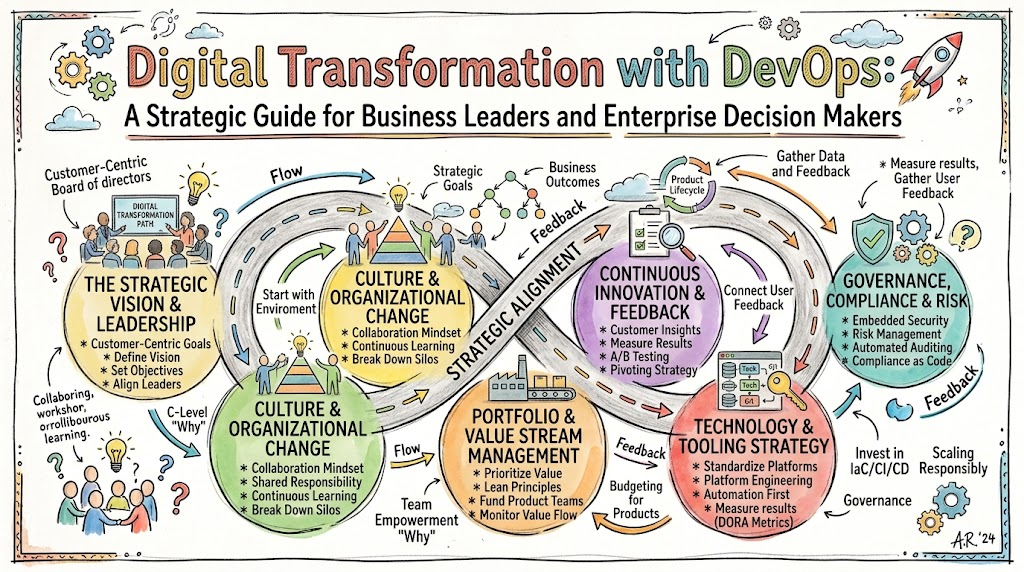
Introduction
Digital transformation is no longer just a technology initiative—it is a business strategy that shapes how organizations innovate, compete, and deliver value to customers. Companies across industries are modernizing legacy applications, adopting cloud services, automating operations, and creating data-driven business models. Yet many transformation projects fail because technology changes faster than organizational processes and skills.
DevOps provides a practical framework for overcoming these challenges. By combining collaboration, automation, continuous delivery, security, and operational excellence, DevOps enables organizations to accelerate innovation while maintaining reliability and governance.
This guide explains how business leaders can use DevOps as the foundation for sustainable digital transformation, align engineering investments with business objectives, and prepare their organizations for long-term growth.
Why Digital Transformation Requires More Than Technology
Many organizations believe digital transformation is simply about migrating to the cloud or adopting modern software tools. In reality, successful transformation requires changes across people, processes, governance, and organizational culture.
Key drivers include:
- Customer expectations for faster innovation
- Increasing competition
- Cloud adoption
- Cybersecurity requirements
- Data-driven decision-making
- Regulatory compliance
- Global collaboration
Technology enables transformation, but leadership and strategy determine whether it succeeds.
Aligning Business and Engineering
One of the biggest obstacles to transformation is the disconnect between business priorities and technical execution.
Successful organizations establish shared objectives such as:
- Faster product delivery
- Improved customer satisfaction
- Reduced operational risk
- Better service availability
- Predictable software releases
- Lower infrastructure costs
When engineering metrics support business goals, DevOps becomes a strategic advantage rather than a technical project.
Building a Transformation Roadmap
A structured roadmap helps organizations implement DevOps incrementally.
Typical phases include:
- Current-state assessment
- Process standardization
- Automation of builds and deployments
- Infrastructure as Code adoption
- Cloud modernization
- Kubernetes implementation
- DevSecOps integration
- Site Reliability Engineering
- Platform Engineering
- Continuous optimization
This phased approach reduces risk and supports long-term adoption.
Leadership and Organizational Change
Digital transformation depends on leadership commitment.
Executive teams should:
- Define clear objectives
- Support cross-functional collaboration
- Encourage experimentation
- Invest in employee development
- Measure outcomes
- Promote continuous improvement
Leadership creates the environment in which DevOps practices can thrive.
Cloud as a Business Enabler
Cloud computing provides scalability, flexibility, and faster innovation, but successful adoption requires governance.
Business leaders should consider:
- Cost management
- Security
- Compliance
- Disaster recovery
- Vendor strategy
- Automation
- Operational visibility
Cloud investments deliver greater value when combined with DevOps principles.
Security as a Strategic Priority
Security is increasingly integrated into digital transformation initiatives.
Organizations should adopt DevSecOps practices that include:
- Automated security testing
- Infrastructure validation
- Secure software supply chains
- Continuous compliance
- Identity management
- Secret management
Embedding security into delivery pipelines reduces risk while supporting innovation.
Reliability and Customer Trust
Reliable digital services strengthen customer confidence.
Site Reliability Engineering contributes through:
- Service Level Objectives
- Error budgets
- Incident management
- Automation
- Capacity planning
- Post-incident learning
Reliable services improve both operational performance and business reputation.
Building Future-Ready Engineering Teams
Technology evolves rapidly, making continuous learning essential.
Organizations should invest in:
- DevOps Corporate Training
- Kubernetes education
- Cloud certifications
- Security workshops
- Platform Engineering skills
- Leadership development
Skilled teams are the foundation of successful transformation.
Measuring Business Impact
Transformation initiatives should be evaluated using measurable outcomes.
Important indicators include:
| Business Metric | Why It Matters |
|---|---|
| Time to Market | Faster delivery of customer value |
| Customer Satisfaction | Better user experience |
| Deployment Frequency | Engineering agility |
| Service Availability | Operational reliability |
| Infrastructure Cost | Financial efficiency |
| Employee Productivity | Team performance |
Business-focused metrics help executives assess the return on technology investments.
The Role of External Expertise
Many organizations accelerate transformation by partnering with experienced DevOps consultants and trainers.
External experts can assist with:
- Strategy development
- Architecture reviews
- Cloud migration planning
- CI/CD implementation
- Kubernetes adoption
- Corporate training
- Governance frameworks
Knowledge transfer ensures internal teams can sustain improvements over time.
Emerging Trends
Business leaders should monitor developments such as:
- AI-assisted software delivery
- Platform Engineering
- Internal Developer Platforms
- GitOps
- FinOps
- Sustainable cloud operations
- Intelligent observability
Understanding these trends helps organizations remain competitive.
Decision Guide
This guide is intended for:
- CEOs leading digital initiatives
- CIOs modernizing enterprise IT
- CTOs adopting cloud-native architectures
- Engineering Directors
- Transformation Program Managers
- Technology Consultants
- Enterprise Architects
Frequently Asked Questions
1. What is digital transformation?
Digital transformation is the process of using technology, automation, and organizational change to improve business operations, customer experiences, and innovation.
2. Why is DevOps important for transformation?
DevOps enables faster software delivery, improved collaboration, automation, and operational reliability, making it a key enabler of digital transformation.
3. How does cloud computing support business goals?
Cloud platforms provide scalability, flexibility, and faster access to technology while reducing infrastructure management complexity.
4. What role does leadership play?
Leadership aligns technology initiatives with business objectives, supports cultural change, and ensures continuous improvement.
5. Why invest in DevOps Corporate Training?
Training helps employees develop the skills required to adopt new technologies, improve collaboration, and sustain transformation efforts.
6. What is Platform Engineering?
Platform Engineering creates standardized internal platforms that simplify software delivery and improve developer productivity.
7. How should organizations measure transformation success?
Measure both technical indicators and business outcomes such as deployment frequency, service availability, customer satisfaction, and time to market.
8. Why integrate security into DevOps?
DevSecOps embeds security into development workflows, reducing vulnerabilities without slowing software delivery.
9. What is the value of Site Reliability Engineering?
SRE improves service reliability through measurable objectives, automation, and structured incident management.
10. How can organizations begin their transformation journey?
Start with an assessment of current capabilities, define business objectives, automate core processes, invest in training, and implement improvements incrementally.
Conclusion
Digital transformation succeeds when organizations align technology, people, and business strategy. DevOps provides the operational framework that enables continuous delivery, cloud modernization, security integration, and reliable software services. By investing in leadership, structured implementation, and ongoing workforce development, enterprises can build resilient digital capabilities that support long-term innovation and sustainable business growth.
