Introduction
Business travel often involves tight schedules, client meetings, conferences, office visits, and airport transfers. Whether you are travelling to another city for a short meeting or attending a multi-day corporate event, reliable transportation can make your journey easier and more productive.
Public transportation is often affordable, but it may not provide the flexibility needed when meetings are spread across several locations. Taxis can be convenient for individual journeys, although frequent rides between airports, hotels, offices, and conference venues may increase travel expenses. Renting a car offers another option, allowing business travelers to plan their journeys around their own schedules.
An airport and city car rental for business trips can help professionals travel between destinations with greater independence. Depending on the provider, you may be able to collect a vehicle at an airport, pick it up from a city rental location, or arrange collection at an agreed meeting point.
In India, professionals visiting Delhi, Mumbai, Bengaluru, Pune, Hyderabad, Chennai, Kolkata, Jaipur, and Goa may need different transportation arrangements depending on their schedules and destinations. Travelers visiting Europe should also understand local driving regulations, insurance conditions, parking rules, and rental requirements before booking. MotoShare Europe
This guide explains how airport and city car rentals work, how to select the right vehicle, which documents may be required, how to manage costs, and how to avoid common booking mistakes.
Why Business Travelers Choose Airport and City Car Rentals
Business trips require dependable transportation. A suitable rental vehicle can simplify travel arrangements, especially when several appointments are scheduled throughout the day.
Convenient Airport Transfers
Arriving at an unfamiliar airport can make transportation planning challenging. A pre-booked rental car may help you travel directly to your hotel, office, conference venue, or client meeting.
Airport pickup can be particularly useful when your flight arrives early in the morning or late at night. However, pickup locations, opening hours, vehicle availability, and airport surcharges vary by provider.
Before booking, confirm whether the car is collected from an airport rental desk, a nearby rental office, or a designated parking area.
Flexible Travel Between Meetings
Business appointments rarely take place in one location. You might need to visit an office park in the morning, meet a client in the afternoon, and attend a networking event in the evening.
A rental car lets you organize these journeys according to your schedule. It can also provide space for laptops, presentation materials, samples, and luggage without requiring you to arrange separate transfers.
Better Control Over Travel Expenses
Renting a car can help businesses estimate transportation costs in advance. However, the advertised daily rate may not include fuel, tolls, parking, insurance upgrades, or additional driver charges.
For a trip involving several stops, compare the complete rental cost with the estimated cost of taxis and other transport options. A rental car is not automatically cheaper, but it may offer better value when multiple journeys are involved.
Greater Privacy and Comfort
Business travelers sometimes need to travel with confidential work materials or prepare for meetings between appointments. A private vehicle offers more personal space than public transportation.
Drivers should never handle a phone or conduct distracting work while driving. Schedule calls before departure or after parking safely.
Airport Car Rental vs. City Car Rental
Airport and city rental locations serve different travel needs. The right choice depends on where your trip begins and how frequently you need a vehicle.
Airport Car Rental
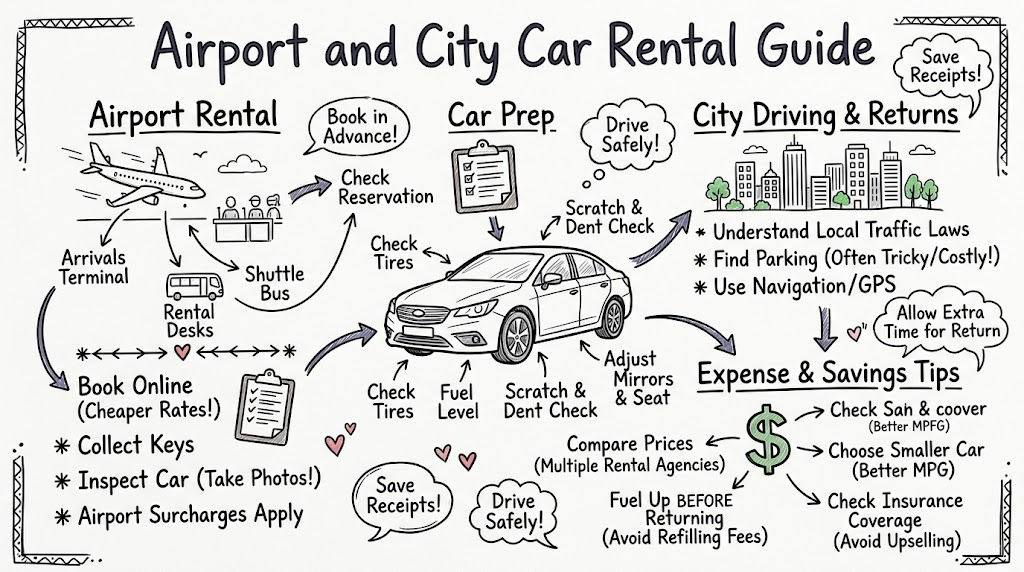
Airport rentals are designed for travelers arriving by air. Collecting a car at or near the airport can reduce the need for an additional transfer to a rental office.
Airport car rental may suit you if:
- You need to drive directly to a business meeting after landing.
- You have several bags or presentation materials.
- You are unfamiliar with local public transportation.
- You need a vehicle for travel beyond the airport area.
Airport rentals may include location-specific charges or higher rates. Compare the total price with an alternative city pickup before confirming your reservation.
City Car Rental
City rental locations can be convenient when you are already staying at a hotel or working in a business district.
A city pickup may suit travelers who spend their first day attending meetings near their hotel and need a car only later in the trip.
City rental locations may also provide practical access to residential areas, offices, and local vehicle providers.
Before choosing a city pickup, consider the time and cost required to reach the rental location.
Who Should Consider Renting a Car for Business Travel?
Car rentals can be useful for several types of professional journeys.
Corporate employees: Professionals attending client meetings, internal reviews, conferences, and training programs may benefit from flexible transportation.
Consultants and sales representatives: People visiting multiple customers or project sites may find a rental car more practical than arranging separate taxi journeys.
Entrepreneurs and business owners: Business owners attending supplier meetings, trade exhibitions, or networking events can organize their schedules more independently.
International business travelers: Visitors arriving in an unfamiliar country may appreciate reserving a vehicle before departure, provided they meet local driving and rental requirements.
Teams travelling together: A larger vehicle may accommodate colleagues and shared luggage. Compare its total cost with separate transport arrangements before deciding.
For short trips involving one destination, public transportation or a taxi may be simpler. Renting a car is most useful when flexibility and multiple stops are important.
How to Choose the Right Rental Car for a Business Trip
Choosing a vehicle involves more than selecting the lowest advertised rate. Consider your itinerary, passenger count, luggage, driving conditions, and business requirements.
Economy Cars for Budget-Conscious Travel
Economy cars are suitable for solo travelers or small groups who need practical transportation between airports, hotels, and offices.
They may be easier to park and can have lower rental rates than larger vehicles. However, luggage capacity and passenger comfort vary by model.
Sedans for Professional Travel
Sedans may suit business travelers who want a comfortable vehicle for client visits, highway journeys, and daily commuting between meetings.
Check luggage capacity, seating comfort, air-conditioning, and fuel efficiency before booking.
SUVs for Longer Journeys
SUVs can be appropriate when your itinerary involves longer road trips, additional luggage, or travel on varied road surfaces.
They generally require more parking space and may cost more to rent and operate than smaller cars. Choose one when its additional space or capability is useful.
Premium Cars for Executive Travel
Premium vehicles may be suitable for executive visits, corporate events, or occasions where comfort and presentation are important.
Before selecting a premium model, check whether the rental price includes sufficient mileage, suitable insurance coverage, and any additional driver fees.
Electric Cars for Suitable Routes
Electric vehicles may be practical for business trips within areas that have reliable charging infrastructure.
Before booking, identify charging locations near your hotel, office, and planned route. Confirm the vehicle’s expected range, charging arrangements, and return-charge requirements.
Documents Usually Required for Car Rental
Rental documentation varies by country, provider, vehicle category, and customer eligibility. Business travelers should confirm requirements before making a reservation.
Valid Driving License
You generally need a valid driving license appropriate for the vehicle category.
International visitors should verify whether their home-country license is accepted and whether an International Driving Permit (IDP) or official translation is required.
An IDP generally accompanies the original license rather than replacing it. Requirements vary by destination, so check the rules for the specific country.
Government-Issued Identification
Rental companies commonly request a passport or another accepted identification document. Domestic travelers may be able to use a government-issued identity document, depending on the provider.
Ensure the name on your booking matches your identification and driving license.
Payment Card and Security Deposit
Some providers require a credit card in the main driver’s name for payment or a refundable security deposit. Others accept alternative payment methods under specific conditions.
Check the deposit amount, refund timeline, and accepted cards before booking. Do not assume every provider accepts debit cards or cash deposits.
Business Travel Details
Your company may require a booking confirmation, travel authorization, expense account information, or invoice details for reimbursement.
If the company is paying, clarify whether the booking must be made through a corporate account and whether additional drivers need to be registered.
What to Check Before Confirming a Rental
Reading the rental terms carefully can prevent unexpected costs and travel disruptions.
Total Rental Price
Compare the final payable amount rather than relying only on the advertised daily rate.
Check for:
- Airport or location surcharges.
- Taxes and service fees.
- Insurance and damage protection charges.
- Additional driver fees.
- Mileage limits.
- Fuel or charging requirements.
- Late-return penalties.
- One-way rental charges.
Ask for clarification if any charge is unclear.
Insurance and Damage Protection
Understand what protection is included in the rental agreement. Coverage can differ in relation to collision damage, theft, third-party liability, deductibles, and exclusions.
A lower excess or deductible may be available at an additional cost. Check whether the policy covers all intended drivers and destinations.
Do not assume that personal travel insurance or a credit card benefit automatically covers every rental-related risk.
Vehicle Condition
Inspect the vehicle before driving away. Record existing scratches, dents, broken lights, damaged tires, and other visible problems.
Take photographs or videos and ensure that existing damage is documented in the rental agreement or pickup record.
Check the fuel level, odometer, mirrors, lights, brakes, and warning indicators. Report safety concerns before starting the journey.
Pickup and Return Arrangements
Confirm the pickup address, opening hours, contact details, and procedures for delayed flights.
Verify the return location and deadline. If you plan to return the vehicle at a different location, confirm that one-way returns are permitted and check the associated fee.
Mileage and Fuel Policies
Some rentals include unlimited mileage, while others restrict the distance you can travel. Additional mileage charges may apply.
Fuel policies also vary. A full-to-full arrangement usually requires returning the vehicle with the same fuel level as at pickup. Electric rentals may have separate charging requirements.
Airport and City Car Rental Costs for Business Trips
Rental prices depend on the country, city, season, vehicle type, booking duration, availability, insurance selection, and pickup location.
The following figures are illustrative planning ranges for domestic rentals in India, not live quotations or guaranteed rates.
| Vehicle category | Illustrative daily rental range |
|---|---|
| Economy hatchback | ₹1,500–₹3,000 |
| Compact or mid-size sedan | ₹2,000–₹4,500 |
| SUV | ₹3,000–₹7,000 |
| Premium car | ₹5,000–₹15,000 or more |
Actual prices can fall outside these ranges. Chauffeur-driven rentals, self-drive rentals, and airport-specific offers may have different pricing structures.
Factors That Affect Rental Prices
Rental duration: Weekly bookings may offer a lower average daily rate than individual daily bookings, depending on the provider.
Location: Airports, city centers, and suburban pickup points can have different fees and vehicle availability.
Vehicle category: Larger and premium vehicles generally cost more than economy cars.
Booking timing: Rates can change with demand, local events, holidays, and available inventory.
Insurance and extras: Additional protection, child seats, extra drivers, and other optional services may increase the total.
Return arrangements: Returning a car to a different location can attract a one-way fee.
How to Manage Your Business Travel Budget
To estimate the real cost of a rental, calculate the expected total rather than multiplying the advertised daily rate by the number of days.
Include the rental charge, taxes, fuel or charging, parking, tolls, insurance, deposit requirements, and additional services.
If you have several meetings in a city, compare a multi-day rental with taxi estimates for the same itinerary. If you only need a single airport transfer, a taxi may be more economical.
Driving in Indian Business Cities
India’s business centers have different traffic patterns, road conditions, parking arrangements, and travel distances. Plan your transportation according to your itinerary.
Delhi
Business travelers visiting Delhi may need to travel between the airport, central business districts, Gurugram, and Noida. Traffic can be heavy during peak periods, so allow additional time for meetings.
Check parking availability at each destination and confirm whether your rental vehicle can be taken across state borders.
Mumbai
Mumbai’s traffic, limited parking, and long cross-city journeys can affect meeting schedules. A rental car may be useful for several appointments, but public transportation or taxis may be more practical for short journeys in congested areas.
Bengaluru
Bengaluru’s technology parks and business districts can be spread across the city. If you have meetings at multiple offices, map the route beforehand and account for rush-hour delays.
Pune and Hyderabad
Pune’s industrial and technology areas and Hyderabad’s IT corridors may involve substantial travel between appointments. Choose a vehicle based on the distance, passenger count, and expected luggage.
Chennai and Kolkata
In Chennai, plan for traffic when travelling between business districts and the airport. In Kolkata, consider parking and congestion when scheduling visits across different parts of the city.
Jaipur and Goa
Jaipur may involve travel between hotels, industrial areas, offices, and conference venues. In Goa, a rental vehicle can be useful for reaching business meetings spread across different areas, although local traffic and parking should still be considered.
For international trips to Europe, verify local driving regulations, environmental zones, toll requirements, parking restrictions, and cross-border rental permissions before departure.
Airport and City Car Rental vs. Taxis and Public Transport
The most suitable transport option depends on how many journeys you need to make, the distance involved, and your budget.
| Factor | Rental car | Taxi or ride-hailing | Public transport |
|---|---|---|---|
| Cost | Can offer value for frequent trips; fuel and other charges apply | Pay per journey; frequent rides may become expensive | Often economical for routine routes |
| Convenience | Flexible when a vehicle is available for the full rental period | Convenient for direct point-to-point travel | Depends on routes, schedules, and transfers |
| Flexibility | High within rental terms and driving rules | Moderate; availability and fares may vary | Limited by operating routes and timetables |
| Comfort | Private space and control over the journey | Private ride without self-driving | Varies by service and crowd levels |
| Travel experience | Independent travel and greater control over stops | Minimal driving responsibility | Opportunity to experience local transport |
| Best use cases | Multiple meetings, road travel, several passengers | Airport transfers and short trips | Regular routes and congested city centers |
A rental car is not always the fastest option. In crowded urban areas, public transportation can sometimes be more predictable. Compare the actual itinerary instead of choosing solely on convenience.
Common Car Rental Mistakes to Avoid
Business travelers can reduce unnecessary expenses and delays by avoiding several common mistakes.
Booking Without Reading the Terms
A low advertised rate may exclude important charges. Read the agreement and confirm the final price before paying.
Choosing the Wrong Vehicle
A small car may be sufficient for one person but unsuitable for a team carrying luggage or presentation equipment. Match the vehicle to your actual requirements.
Ignoring Pickup Delays
Airport pickup procedures can take time, especially when documentation checks or vehicle inspections are required. Leave enough time between landing and your first meeting.
Failing to Document Existing Damage
Without clear pickup records, disagreements about vehicle damage may arise. Photograph the vehicle and report existing issues before departure.
Returning the Vehicle Late
Late-return fees can increase the total cost and disrupt subsequent bookings. Plan for traffic, refueling, charging, and the final inspection.
Forgetting Parking and Toll Costs
Parking fees, tolls, and city-specific charges can add up during a multi-day business trip. Include them in your expense estimate.
Assuming Every Rental Includes the Same Coverage
Insurance terms, mileage allowances, deposits, and breakdown assistance differ between providers. Verify these details before confirming the booking.
How to Make Your Business Trip More Efficient
A little planning can make rental travel more productive.
- Prepare your itinerary: List all meeting addresses, hotel details, and expected arrival times.
- Choose a suitable pickup point: Compare airport collection with a nearby city rental office.
- Book an appropriate vehicle: Consider comfort, luggage space, parking, and fuel economy.
- Confirm the documents: Check license eligibility, identification, payment requirements, and deposit terms.
- Review the route: Estimate driving time and identify suitable parking facilities.
- Keep booking information accessible: Save the rental agreement, provider contact details, and roadside assistance number.
- Track expenses: Retain invoices and receipts for company reimbursement.
- Allow a time buffer: Leave extra time for traffic, pickup procedures, and unexpected delays.
If the trip includes several colleagues, compare the cost of one larger rental with separate vehicles or individual taxi rides.
How MotoShare Europe Can Help Business Travelers
MotoShare Europe can be a starting point for exploring vehicle rental and sharing options relevant to your travel plans. Before relying on a particular vehicle or service, verify the availability and rental terms for your destination through the platform.
Explore Suitable Vehicle Options
Business travelers have different needs. Some may require a compact car for city meetings, while others need a larger vehicle for colleagues or equipment.
Compare available vehicle categories, rental duration, and pickup arrangements to identify an option that matches your itinerary.
Review Pricing Before Booking
A clear understanding of the total cost can help you plan your travel budget. Check the listed rental price, deposit, insurance terms, mileage limits, and additional fees before making a commitment.
Check Pickup and Return Flexibility
If your trip begins at an airport and ends in a city, verify whether the selected provider supports the required pickup and return locations. Availability and one-way rental policies may vary.
Plan Ahead for Business Travel
Booking in advance can give you more time to compare vehicles and review the rental agreement. For trips involving conferences, major events, or several meetings, confirm availability early and keep the provider’s contact details accessible.
The specific services, participating vehicle owners, booking features, and city coverage offered by MotoShare Europe should be confirmed on the platform before booking.
Frequently Asked Questions
1. Is airport car rental suitable for business trips?
Yes. Airport car rental can be convenient when you need to travel directly from the airport to a hotel, office, conference, or client meeting. Compare the total price with city pickup and other transport options.
2. Is airport car rental more expensive than city car rental?
It can be, but not in every case. Airport surcharges, local demand, and vehicle availability can affect prices. Compare the final quotation for both locations before deciding.
3. What documents do I need to rent a car?
Common requirements include a valid driving license, accepted identification, and an eligible payment card. International travelers may need an IDP or a license translation, depending on local regulations.
4. Can international business travelers rent a car in Europe?
In many European destinations, international visitors can rent cars if they meet the applicable age, license, identification, and payment requirements. Rules differ by country and rental company, so verify them before travelling.
5. How much does a rental car cost per day in India?
As an illustrative estimate, an economy self-drive car may cost around ₹1,500–₹3,000 per day, while SUVs and premium cars may cost more. Actual rates vary by city, provider, dates, insurance, and rental conditions.
6. Is a security deposit required?
Many rental providers require a refundable deposit or payment-card preauthorization. The amount, payment method, and release timeline depend on the provider and vehicle category.
7. Can I collect a rental car at the airport and return it in the city?
Some providers permit this arrangement, while others require returns to the original location. Confirm availability and any one-way fee before booking.
8. Is insurance included in the rental price?
Some form of coverage may be included, but the scope differs. Check third-party liability, damage protection, theft coverage, deductibles, and exclusions in the agreement.
9. Is renting a car better than taking taxis for business meetings?
It depends on the itinerary. A rental car may be practical for frequent journeys to several locations, while taxis can be simpler for isolated trips or airport transfers. Compare the full expected cost.
10. Can I extend my rental if a business meeting runs late?
Extensions depend on the rental agreement and vehicle availability. Contact the provider as soon as possible rather than assuming a late return will be accepted without additional charges.
11. What should I do if the rental car breaks down?
Move to a safe location if possible, contact the rental provider’s breakdown assistance number, and follow the instructions provided. Do not arrange expensive repairs without authorization unless required to address an immediate safety emergency.
12. How far in advance should I book a business rental car?
Booking early is useful when travelling during busy periods or attending major events. The appropriate lead time depends on the destination, vehicle category, and availability. Confirm the reservation details before departure.
Conclusion
Airport and city car rentals can make business travel more flexible by helping professionals manage airport transfers, client visits, conferences, and multi-stop itineraries. The right vehicle can provide comfort, privacy, and greater control over travel schedules, but it is important to compare the full cost with taxis and public transportation.
Before booking, verify the driving requirements, documents, insurance coverage, deposit, mileage policy, pickup location, and return arrangements. Business travelers visiting Indian cities such as Delhi, Mumbai, Bengaluru, Pune, Hyderabad, Chennai, Kolkata, Jaipur, and Goa should also account for traffic, parking, tolls, and travel distances.
For international journeys across Europe, check the applicable local regulations and rental conditions before making a reservation.
Plan your next business journey with confidence. Explore the vehicle rental options available through MotoShare Europe, compare the terms that matter to you, and choose a suitable vehicle for your next airport transfer or city business trip.
Visit MotoShare Europe to explore the platform and check the available rental options for your destination.
